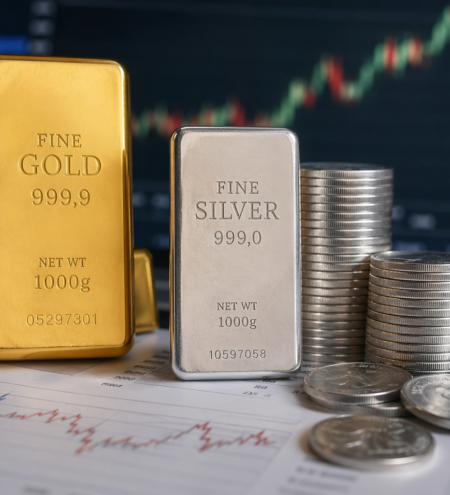
Gold at US$13,000–US$13,600 an ounce by 2029–2031? It may sound extraordinary, but market analyst Gareth Soloway believes long-term monetary and debt trends could push gold dramatically higher over the next five years.
Soloway’s modelling points towards a potential gold peak in the US$13,000-plus range between 2029 and 2031. Some reports of his modelling put the target at approximately US$13,600.
That is not a prediction for next month or even the end of this year. It is a long-term scenario based on several major economic forces including debt growth, money supply, interest rates and confidence in fiat currencies.
Gold Has Reached a Remarkable Reserve Milestone
One of the most interesting developments supporting the long-term gold story is gold’s changing position within global official reserves.
According to the European Central Bank, gold accounted for approximately 27% of global official foreign reserves at the end of 2025, compared with around 22% for US Treasuries.
However, there is an important qualification.
The increase in gold’s share was driven significantly by the dramatic rise in the market price of gold, rather than simply by central banks accumulating enormous additional quantities of bullion. The Federal Reserve has also cautioned against interpreting the figures as proof that gold has completely displaced US Treasuries as the world’s dominant reserve asset.
Nevertheless, the change is significant.
Central banks around the world continue to hold substantial amounts of gold, and the metal remains attractive because it carries no issuer or counterparty risk.
America’s Gold Is Still Officially Valued at Just $42.22
The United States provides another fascinating example.
The US government holds approximately 261.5 million fine troy ounces of gold. Treasury accounting, however, values that gold at the statutory rate of US$42.2222 per ounce a figure established under US law.
At today’s market prices, the same quantity of gold would be worth well over US$1 trillion.
That enormous difference between the statutory book value and the market value raises an obvious question:
What would happen if the United States revalued its official gold holdings?
A revaluation would not create additional gold and would not, by itself, eliminate America’s national debt. But it could substantially increase the reported dollar value of the government’s gold reserves and alter the accounting relationship between the Treasury’s gold holdings and its liabilities.
For investors, the more important point is what the difference illustrates: gold can have a very different value depending on the monetary system and accounting framework used to measure it.
Two Different Models — A Similar Destination
Soloway’s long-term argument is based on more than simply extrapolating today’s gold price.
His modelling considers several forces that could potentially drive gold substantially higher:
- Continued growth in US government debt and annual borrowing
- Expansion of global money supply
- Falling or persistently low real interest rates
- Increasing concern about fiat currencies
- Greater demand for gold as a monetary and portfolio hedge
One of his approaches looks at gold in relation to the US M2 money supply.
The idea is relatively straightforward: if the relationship between gold and the money supply were eventually to return towards the extreme levels seen around the 1980 gold peak, the implied gold price could be dramatically higher than today’s levels.
According to Soloway’s calculations, that analysis again points towards a gold price in the US$13,000-plus region.
Two different approaches — one based on broader monetary and economic conditions and another comparing gold with M2 arrive at a remarkably similar long-term destination.
But Could Gold Really Reach US$13,000?
That is the big question.
A forecast of US$13,000–US$13,600 gold would represent a massive increase from today’s levels. It should therefore be viewed as a long-term scenario rather than a certainty.
The assumptions behind the forecast could change.
Interest rates could remain higher for longer. Governments could reduce deficits. Inflation could fall. The US dollar could strengthen. Central-bank gold buying could slow. And, as Soloway himself has acknowledged, gold could experience substantial corrections along the way.
In other words, the path to a much higher gold price if it happens is unlikely to be a straight line.
Perhaps Gold Isn’t Getting More Valuable, Perhaps the Measuring Stick Is Losing Value
There is another way to look at the argument.
Gold is ultimately measured in currencies such as the US dollar. If governments continue expanding debt and money supply faster than confidence in those currencies can absorb, the price of scarce real assets can rise substantially in nominal terms.
That doesn’t necessarily mean the underlying asset has suddenly become more valuable.
It can also mean that the currency used to measure it has become less valuable.
This is one of the central arguments behind the long-term bullish case for physical gold.
So, Is US$13,600 Gold Realistic?
Perhaps.
But whether gold reaches US$13,000, US$13,600, or some completely different level will depend on economic conditions that cannot be known with certainty today.
What is undeniable is that gold’s role in the global financial system is changing.
Central banks continue to hold significant quantities of gold, gold’s share of official reserves has risen sharply, and governments around the world continue to grapple with historically high levels of debt.
For long-term physical bullion investors, the question may therefore be less about predicting the exact price of gold in 2030 and more about understanding why central banks, institutions and private investors continue to regard physical gold as a store of value.
Could we see US$13,000–US$13,600 gold by 2029–2031, or is that simply too optimistic?
That is the debate.
This article is for general information only and does not constitute financial advice. Gold and other precious metals can fall as well as rise in value. Investors should consider their own circumstances and seek independent financial advice where appropriate.