Rising energy prices, renewed inflation concerns and expectations of tighter US monetary policy are weighing on gold, but the latest correction raises a bigger question: are investors abandoning the metal, or are short-term traders reacting to a changing interest rate outlook?
Gold prices fell by more than 2% as surging oil prices intensified inflation concerns ahead of the Federal Reserve’s upcoming policy meeting. Spot gold dropped towards US$4,050 per ounce, while Brent crude climbed to a five-month high of approximately US$112 per barrel following deadly attacks in Saudi Arabia that heightened concerns about regional oil supplies.
The decline has added to a difficult period for gold, which has retreated sharply from record levels above US$5,500 per ounce earlier in the year. After a spectacular rally, the precious metal is now facing a combination of rising energy costs, elevated bond yields, uncertainty over interest rates and a stronger US dollar.
Yet falling prices do not necessarily mean that the underlying reasons for holding physical gold have disappeared. Instead, the current market demonstrates how gold can come under pressure even when inflation, geopolitical instability and concerns about the global financial system remain prominent.
Oil Prices Rise and Gold Comes Under Pressure
The recent surge in crude oil prices has complicated the outlook for central banks.
Higher energy costs feed into transportation, manufacturing, electricity and household expenses. If these increases persist, inflation can become more difficult to control, potentially forcing central banks to maintain restrictive monetary policies for longer.
Gold is often regarded as a hedge against inflation, but its price does not always rise when inflation accelerates.
The reason is the relationship between inflation, interest rates and the US dollar. If investors expect central banks to raise interest rates to contain rising prices, interest-bearing assets can become more attractive relative to gold, which does not generate an income.
This dynamic has been a major headwind for the precious metal as energy prices and inflation expectations have risen.
According to the supplied market report, recent US consumer and producer inflation figures came in hotter than expected, strengthening expectations that monetary policy could remain restrictive.
David Meger, director of metals trading at High Ridge Futures, noted that renewed inflationary pressure was increasing concerns about further Federal Reserve rate increases.
Markets were reportedly expecting the Fed to hold rates steady at its October meeting, while continuing to assess the possibility of another increase later in the year.
The key issue for gold is not simply whether inflation is rising, but how central banks respond and what that means for real interest rates, bond yields and the US dollar.
For further background, read FirstGold’s guide to what moves gold and other precious metal prices.
Why Gold Can Fall During Geopolitical Uncertainty
Gold has traditionally attracted demand during periods of war, financial instability and geopolitical uncertainty. However, the recent market has demonstrated that this relationship is not always straightforward.
The same geopolitical events that encourage investors to seek safety can also disrupt energy supplies, push oil prices higher and intensify inflation.
If those developments increase expectations of higher interest rates, gold can face selling pressure despite the elevated level of uncertainty.
This creates a difficult environment for short-term traders. Gold may benefit from safe-haven demand, only to be undermined by the monetary policy consequences of rising energy prices.
Broader financial market volatility has added to the pressure. Declining equity markets and disappointing technology earnings have contributed to investor uncertainty, while some market participants have reduced exposure to assets experiencing sharp price swings.
Alex Carrier, portfolio manager at DNCA Finance, described the precious metals market as undergoing a capitulation phase, with volatility potentially remaining elevated around the Federal Reserve meeting.
Economists at Intesa Sanpaolo also anticipated continued uncertainty, suggesting gold could lack a clear direction in the near term.
The lesson is that no single factor determines the gold price. Interest rates, currencies, energy prices, investment flows and physical demand can all exert competing influences.
Gold Gives Back Earlier Gains
The scale of the recent correction is significant when viewed against gold’s extraordinary performance in 2025 and early 2026.
Gold recorded an approximately 63% annual gain in 2025, according to the supplied report, as investors responded to economic uncertainty, central bank purchases and expectations of changing monetary conditions.
Prices subsequently moved above US$5,500 per ounce earlier this year before reversing sharply.
With spot gold falling towards US$4,050, the metal has surrendered a substantial portion of its recent gains. The correction has also exposed differences across the mining industry, where larger producers with stronger balance sheets may be better placed to withstand price volatility than smaller companies facing higher operating costs or financing constraints.
For investors, it is important to distinguish between the gold price itself and the performance of gold mining shares. Mining companies have operating expenses, management decisions, financing requirements and production risks that do not apply in the same way to directly owned bullion.
A fall in gold prices can therefore have a different impact on a mining company’s share price than on the value of physical gold held by an individual.
Jewellery Demand and Investment Demand Tell Different Stories
The market outlook is also being influenced by changes in consumer demand.
Intesa Sanpaolo has pointed to a sharp contraction in global jewellery demand as one factor that could limit gold’s near-term performance.
High prices can discourage jewellery purchases, particularly in price-sensitive markets where consumers may reduce the weight of gold they buy or postpone purchases altogether.
However, jewellery demand is only one part of the global market.
Investment demand, central bank purchases, physical bar and coin buying, recycling and mine production also influence the balance between supply and demand.
A decline in jewellery purchases does not automatically mean that all other forms of gold demand are weakening. Investors seeking diversification or protection against financial uncertainty may continue buying bullion even when consumers become more reluctant to pay elevated prices for jewellery.
This distinction matters when interpreting headlines about falling demand. The gold market is made up of different groups of buyers with different motivations, time horizons and sensitivities to price.
Physical Bullion Versus Short-Term Trading
The latest sell-off also highlights the difference between trading gold through leveraged financial instruments and accumulating physical bullion.
Short-term traders may react rapidly to changes in interest rate expectations, technical price levels and currency movements. Leverage can amplify both gains and losses, making sudden corrections particularly challenging.
Physical bullion ownership is different. The holder owns metal rather than relying solely on a financial position linked to its price.
That does not mean physical gold is immune to market declines. Its market value can fall substantially, and the price received when selling may differ from the international spot price because of product premiums, buy-back spreads and other applicable costs.
Understanding these differences is essential for anyone considering physical precious metals.
FirstGold explains the distinction in its article on the physical bullion spread and why the price you pay is not necessarily the price you receive when selling.
The important point is to understand what you own, the costs involved and the purpose the asset serves within your broader financial circumstances.
Could Cost Averaging Help Navigate Volatility?
With gold experiencing sharp price movements, some buyers may be reluctant to make a large purchase at a single point in the market.
One alternative is cost averaging, which involves purchasing a fixed dollar amount of metal at regular intervals rather than attempting to identify the perfect entry price.
When prices fall, the same dollar amount buys more metal. When prices rise, it buys less. Over time, purchases are made at different prices, creating an average acquisition cost.
Cost averaging does not guarantee a profit, prevent losses or ensure that an investor will outperform someone who buys at a particularly favourable price. However, it can reduce the need to make every purchasing decision based on short-term market predictions.
For those interested in how this approach works, FirstGold has published a detailed explanation of cost average purchasing for gold and silver.
The approach is particularly relevant to people whose objective is to accumulate physical bullion gradually rather than trade every market movement.
Silver Remains Part of the Bigger Picture
Gold is not the only precious metal attracting attention. Silver has its own market dynamics, combining investment demand with substantial industrial uses.
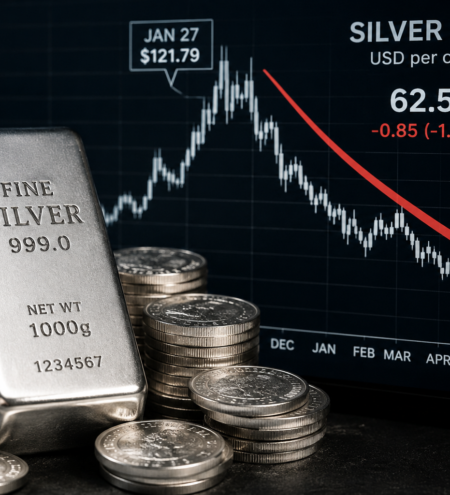
The supplied report indicates that silver remained approximately 17% higher on a trailing 12-month basis, even as gold surrendered much of its earlier advance. Such differences highlight that the two metals do not always move in tandem.
Silver can experience larger percentage swings than gold because of its industrial exposure, changing investment sentiment and the relative size of its market.
For Australians considering both metals, FirstGold’s analysis of cost averaging through gold, silver and the gold-silver ratio explores how their relative performance can change over time.
Neither metal is guaranteed to rise, and both can experience extended periods of weakness.
FirstGold Perspective: The Price Is Changing, but the Bigger Questions Remain
Gold’s latest decline shows how quickly market sentiment can shift when oil prices rise and expectations for monetary policy change.
In the short term, higher energy prices, persistent inflation and the prospect of tighter monetary policy may continue to weigh on precious metals. The timing of any recovery remains uncertain, and further price declines cannot be ruled out.
But the broader reasons people consider physical gold extend beyond the next Federal Reserve meeting.
Government debt, currency purchasing power, geopolitical risk and the desire to diversify beyond conventional financial assets remain important considerations for many bullion holders.
For Australians, currency movements also matter. Gold is commonly quoted internationally in US dollars, so changes in the Australian dollar can affect the local price even when the US dollar gold price moves very little.
You can follow precious metal market movements through FirstGold’s live gold price page.
At FirstGold, the focus is on helping customers accumulate physical gold, silver and platinum over time. Rather than assuming that every price decline signals a lasting change in gold’s role, it is worth understanding what is driving the market and how short-term volatility fits within an individual’s longer-term objectives.
There is no reliable way to predict every market peak or bottom. Gold can fall further, remain under pressure or recover unexpectedly as economic conditions change.
The price of gold will always fluctuate. The important question for anyone considering physical bullion is whether they understand why they own it, what it costs to hold and how it fits into their financial plans.
Disclaimer: This article is for general information only and does not constitute financial advice or a recommendation to buy or sell gold, silver or other precious metals. Precious metals can be volatile, and past performance does not guarantee future results.