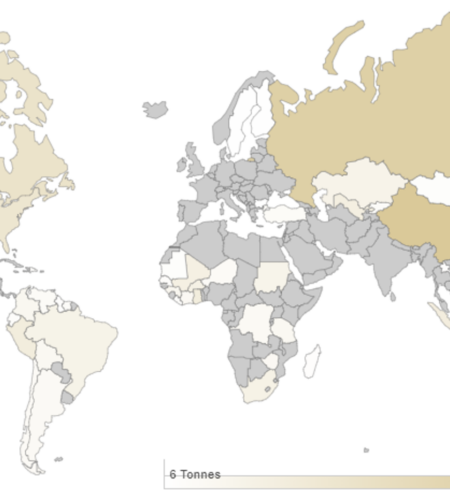
Goldman Sachs Research is sticking with its year-end gold forecast of US$4,900 an ounce. The bank says central banks kept buying heavily through July, and China appears to be accumulating far more bullion than its official figures show.
Goldman’s analysts Lina Thomas and Daan Struyven estimate that central banks bought 44 tonnes of gold in July. That is well over twice the pre-2022 monthly average of 17 tonnes. On a three-month seasonally adjusted basis, buying is running at about 91 tonnes a month.
China’s hidden buying
China was by far the biggest buyer. Goldman’s model puts the People’s Bank of China’s July purchases at 35 tonnes, roughly 75% more than the amount officially disclosed.
The gap comes from how Goldman tracks the market. Official reserve data often understates what central banks are buying, so the bank’s “nowcast” model also follows gold moving through London’s over-the-counter market into domestic vaults and third-party custodians.
The analysts believe even their July estimate is too low. The Bank of England’s gold holdings on behalf of foreign central banks rose by 63 tonnes during the month, far more than the fall in holdings at the Federal Reserve’s New York vaults. That suggests more sovereign buying that hasn’t yet been captured.
The July figures follow a strong June. Goldman estimates sovereign purchases rose to 100 tonnes a month on a three-month adjusted basis, up from 66 tonnes in May, with China again the largest confirmed buyer.
Why central banks keep buying
Goldman sees central bank buying as a trend that will last for years, not a short-term spike. Central banks are diversifying their foreign reserves to protect against geopolitical and financial risk. The bank’s forecast assumes average purchases of 50 tonnes a month in 2026 and 40 tonnes a month in 2027.
Investor demand is also recovering after a slow first half. Markets have scaled back expectations of a US rate hike this year, and Goldman’s economists expect lower inflation to keep the Fed on hold. That should help gold-backed ETFs, whose investors tend to sell when rates rise.
Upside risk, and a bumpier ride
Goldman says the risks to its forecast lean to the upside. Gold still makes up a small share of private portfolios. The analysts suggest that geopolitical tensions, including those involving Iran, and worries about Western government finances could push private investors to follow central banks into the metal.
The bank’s $4,900 target also leaves out one factor: rising demand for gold call options, which investors are buying to hedge against big shifts in government policy. As prices near key strike levels, the dealers who sold those options have to buy gold to cover their positions, which speeds up the rally. If ETF inflows recover and this options positioning holds, Goldman says prices could go well above its forecast.
The same mechanism works in reverse. A fall in prices, or a renewed expectation of Fed rate hikes, could make dealers unwind those hedges by selling gold, causing a sharper correction than usual. In a scenario where the Fed does hike, Goldman sees gold ending 2026 at around US$4,440 an ounce. That is well below its base case but still slightly above current levels, because continued central bank buying would eventually outweigh the selling.
Put simply, the analysts expect “greater two-sided volatility” as gold heads higher.
Disclaimer: This article is for general information purposes only and does not constitute financial, investment or trading advice.