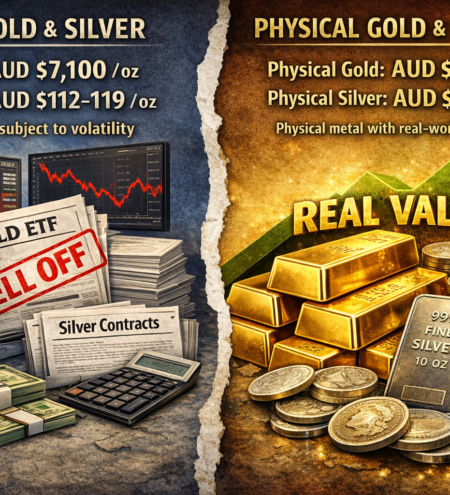
Gold and silver have staged a strong recovery, with gold climbing back above US$4,000 an ounce as a weaker US dollar and falling Treasury yields improve demand for precious metals. Meanwhile, central bank purchases remain a powerful signal of continued confidence in physical gold as a strategic reserve asset.
Gold prices surged on Wednesday, recovering above the psychologically important US$4,000 per troy ounce level following the US midterm election results. A weaker US dollar and declining US Treasury yields helped drive renewed buying interest across the precious metals market.
Gold futures gained approximately 2.8% to US$4,052.50 an ounce during European trading, while silver jumped 4.7% to US$52.11. Platinum also advanced 2.4% to US$1,464.10 an ounce.
Gold briefly gained as much as 3.5%, its strongest daily advance since August, as investors reacted to political uncertainty and changing expectations around US government spending and economic policy.
A weaker dollar generally makes gold more affordable for international buyers, while falling Treasury yields reduce the opportunity cost of holding non-interest-bearing assets such as physical gold and silver.
Central banks continue accumulating gold
Beyond short-term market movements, one of the most significant developments in the precious metals market remains the continued accumulation of gold by central banks.
According to the World Gold Council, global central bank gold purchases reached 321 tonnes in the third quarter of 2026, an increase of 42% compared with the same period last year.
This was the strongest quarterly buying since the end of 2024 and considerably above the five-year quarterly average of 227 tonnes.
The People’s Bank of China was the largest reported buyer, followed by Poland’s National Bank.
Year-to-date purchases by central banks and other official institutions have reached 675 tonnes, approximately 6% higher than the corresponding period last year.
The World Gold Council has subsequently raised its full-year expectations, forecasting that official-sector purchases will at least match the 848 tonnes accumulated during 2025.
The continued buying reflects a broader strategy of portfolio diversification and risk management as governments seek to reduce exposure to traditional financial assets and currency fluctuations.
China’s precious metals inventories: Are we seeing the complete picture?
Another important question facing precious metals investors is how much gold and silver China actually holds.
The true extent of China’s precious metals inventories remains difficult to establish. Official figures do not necessarily capture all privately held metal, commercial inventories, industrial holdings or strategic reserves controlled by different state-linked entities.
This uncertainty is particularly relevant in today’s geopolitical environment, where strategic commodities are increasingly viewed as matters of national security rather than simply economic assets.
China is a major participant in the global gold and silver markets, and its domestic demand, industrial consumption and strategic accumulation can influence international supply and pricing.
Silver deserves particular attention because of its dual role as both a precious metal and an essential industrial commodity. Its use in solar panels, electronics, electrical systems and emerging technologies creates competing demands for available physical supply.
Understanding reported exchange inventories is therefore important, but these figures should not automatically be treated as a complete measure of the metal available within a country.
Physical precious metals remain relevant
The combination of currency uncertainty, government debt, geopolitical tensions and continued central bank accumulation reinforces the role of physical precious metals in wealth preservation.
Central banks are not buying gold because it pays interest or generates dividends. They are accumulating an asset that carries no counterparty liability and is recognised internationally as a reserve of value.
For individual investors, the same fundamental distinction applies. Owning physical gold and silver is different from holding a paper contract, an ETF or an investment product that depends on a financial institution or third party.
Short-term corrections and volatility are an unavoidable part of precious metals markets. However, the continued demand from central banks and the growing importance of strategic commodities suggest that the longer-term monetary role of gold remains firmly relevant.
FirstGold – Build Wealth One Gram at a Time.
FirstGold makes accumulating physical gold, silver and platinum accessible, allowing Australians to purchase progressively rather than attempting to predict market highs and lows.
Through regular accumulation and cost averaging, investors can spread their purchases over time, reducing the pressure of trying to find the perfect entry point.
You don’t need to buy an ounce at a time. Start with what you can afford and build your physical precious metals holdings one gram at a time.
Disclaimer: This article is for general information purposes only and does not constitute financial or investment advice. Precious metals prices are volatile and can rise or fall. Consider your personal circumstances and seek independent professional advice before making financial decisions.