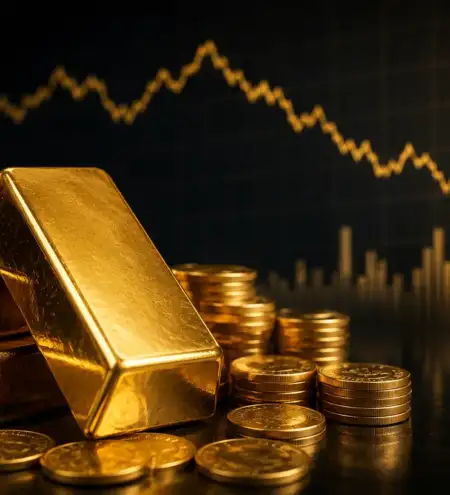
Gold could be heading towards US$6,000 per ounce in 2027, while silver could climb back above US$90, according to precious metals consultancy Metals Focus. However, the forecasts depend on investors regaining confidence amid persistent inflation, geopolitical uncertainty, elevated interest rates and concerns about government debt.
The consultancy’s outlook suggests that the longer term case for precious metals remains intact, even as short term market conditions make further gains less certain.
For gold and silver holders, the key question is whether renewed investment demand will emerge strongly enough to support the next stage of the market.
Gold forecast: US$5,330 average in 2027
Metals Focus expects gold to average US$5,330 per ounce in 2027, approximately 16% above its projected 2026 average of US$4,600.
The consultancy forecasts an average price of US$5,600 during the fourth quarter of 2027, with the potential for gold to approach US$6,000 per ounce.
Matthew Piggott, Director of Gold and Silver at Metals Focus, believes gold’s recent weakness reflects competition for investment capital rather than a fundamental deterioration in its longer term outlook.
Investors have increasingly directed money towards equities, cryptocurrencies, energy and other assets. Meanwhile, elevated bond yields have made interest bearing investments more attractive relative to gold, which does not pay interest.
However, several underlying factors continue to support gold’s role in the global financial system.
-
Government debt and fiscal uncertainty: Rising debt levels and concerns about long term fiscal sustainability continue to encourage investors to consider alternative stores of value.
-
Central bank demand: Official sector purchases remain an important source of support, despite moderating from the exceptionally strong levels recorded between 2022 and 2024.
-
Geopolitical uncertainty: International tensions and concerns about the stability of the global economy continue to underpin demand for precious metals.
-
Currency diversification: Some institutional investors and central banks are seeking to reduce their reliance on traditional dollar denominated assets.
These themes are explored further in our previous coverage of the structural forces reshaping gold’s role in the global monetary system and central bank gold buying.
Inflation and interest rates remain key obstacles
Despite its positive longer term outlook, Metals Focus warns that the timing of gold’s next advance depends heavily on inflation, energy prices and monetary policy.
Higher energy prices can increase inflationary pressures while simultaneously strengthening the US dollar and reinforcing expectations of higher interest rates. This combination can weigh on gold, particularly when investors can earn attractive yields elsewhere.
According to Piggott, a sustained improvement in geopolitical conditions and easing pressure on energy prices could help restore investor confidence.
The analyst also expects the risk of a sharper economic slowdown to remain relevant if monetary policy becomes excessively restrictive.
For gold, the important distinction is between temporary market pressure and a lasting change in the forces supporting demand. Metals Focus believes the structural drivers remain in place, although the recovery could take longer than previously anticipated.
Silver’s return above US$90 depends on investment demand
Silver faces a more complicated outlook than gold because it serves two distinct roles: an industrial metal used in manufacturing and technology, and a precious metal sought by investors.
Metals Focus forecasts an average silver price of US$84.40 per ounce in 2027, up from its projected 2026 average of US$72.60. It expects silver to move above US$90 in the fourth quarter of 2027.
However, the consultancy expects the physical silver market to move from a projected deficit of 35.4 million ounces in 2026 to a surplus of 37.3 million ounces in 2027.
The principal concern is industrial demand, particularly from the solar industry.
Manufacturers have been reducing the amount of silver used in solar panels to improve efficiency and manage production costs. Metals Focus expects industrial silver demand to decline from 640.2 million ounces in 2026 to 618.2 million ounces in 2027.
Demand from electric vehicles, data centres and other applications may help offset some of this decline, but the consultancy does not expect these sectors to compensate fully over the next 12 months.
This means a sustained silver rally may depend less on industrial consumption and more on whether investors return to the market in sufficient numbers.
Why investor confidence matters for silver
Silver’s relatively small market means changes in investment demand can have a significant effect on prices.
Metals Focus believes renewed inflows into silver backed exchange traded products could remove available metal from the market, tighten liquidity and support higher prices.
A concurrent gold rally could also help improve sentiment towards silver, as investors reassess their exposure to precious metals amid economic uncertainty and concerns about government debt.
Nevertheless, the forecast is not without risks. If industrial demand weakens more than expected or investment flows remain subdued, silver may struggle to sustain a move above US$90.
For further background, read our articles on the factors influencing silver prices and the difference between paper and physical gold and silver prices.
What does this mean for Australian physical bullion holders?
International forecasts are quoted in US dollars, while Australian investors generally buy and sell bullion in Australian dollars.
Consequently, the Australian dollar exchange rate is an important consideration. A weaker Australian dollar can increase the local price of gold and silver even if their US dollar prices remain unchanged. Conversely, a stronger Australian dollar can reduce the local price impact of an international rally.
Physical bullion prices also differ from international spot prices because of manufacturing costs, premiums, dealer spreads and market conditions.
For people accumulating physical precious metals, this distinction matters. The price quoted on an international market is not necessarily the price at which a physical bar or coin can be purchased or resold.
Our article on understanding the physical bullion spread explains these differences in more detail.
The bigger picture: patience may matter more than timing
The Metals Focus forecast presents a cautiously optimistic outlook for precious metals. Gold’s longer term prospects remain supported by central bank demand, fiscal uncertainty and currency diversification, while silver’s next major advance may depend more heavily on renewed investor participation.
Neither forecast is guaranteed. Inflation, interest rates, geopolitical developments and changes in industrial demand could all produce a different outcome.
For those who choose to accumulate physical bullion over time, a disciplined approach can reduce the pressure to identify a perfect entry point. Regular purchasing, including dollar cost averaging, is one method of building a position gradually, although it does not eliminate market risk or guarantee a profit.
At FirstGold, the focus is on helping Australians accumulate 100% physical gold, silver and platinum bullion, rather than relying solely on paper exposure to precious metals.
Explore the FirstGold precious metals news for further market analysis, or visit FirstGold to learn more about accumulating physical bullion.
Disclaimer: This article is for general information and educational purposes only and does not constitute financial or investment advice. Price forecasts represent the views of the analysts cited and are not guarantees of future performance. Gold and silver prices can be volatile, and physical bullion involves premiums, transaction costs and the risk of loss. All prices in this article are quoted in US dollars unless otherwise stated. Consider your own circumstances and seek independent professional advice where appropriate.