
Australia is not technically in a recession or depression. But beneath the headline GDP numbers, households are facing a very different economic reality.
There is an important distinction between an economy that is growing and an economy in which people are becoming wealthier.
Australia’s economy continues to grow in aggregate. But when population growth, inflation, productivity, interest rates and GDP per person are taken into account, the picture becomes considerably less comfortable.
The latest figures show an economy caught between persistent inflation and slowing growth.
GDP increased by 0.4% in the June quarter of 2026 and was 2.1% higher over the year. However, GDP per capita increased by only 0.7% over the year, while GDP per hour worked a measure of labour productivity fell 0.2%.
At the same time, inflation remains above the Reserve Bank of Australia’s target range, unemployment has been rising and interest rates have been pushed higher.
So what is actually happening to the Australian economy and what does it mean for people trying to protect their wealth?
Inflation — prices keep rising
Inflation means the general level of prices is rising.
If inflation is 5%, something that cost $100 on average costs approximately $105 a year later.
But there is an important point that is often overlooked.
When inflation falls from 6% to 3%, prices have not fallen. They are simply rising more slowly.
The higher prices accumulated during the inflationary period remain.
This matters because Australians are not starting from the same price level they faced several years ago. Even if inflation eventually returns to the RBA’s 2–3% target range, the purchasing power already lost is not automatically restored.
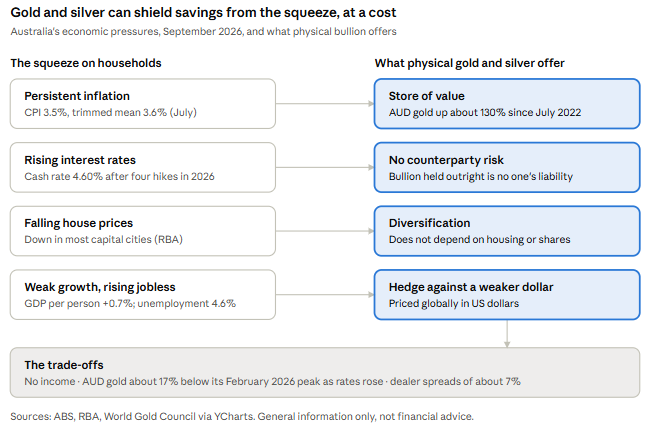
According to the ABS, Australia’s Consumer Price Index rose 3.5% in the 12 months to July 2026. Trimmed mean inflation, which provides an indication of underlying inflationary pressure, remained at 3.6%. Housing was the largest contributor to annual inflation, increasing 5.0%.
Then, on 29 September 2026, the RBA raised the cash rate by another 25 basis points to 4.60%.
That was the fourth interest rate increase of 2026 and took the cash rate to its highest level since late 2011. The RBA said inflation remained elevated and that several upside risks were materialising.
For households carrying mortgages or other debt, higher interest rates add another layer of pressure.
Deflation — the opposite problem
Deflation is the opposite of inflation.
It occurs when the general price level actually falls:
$100 → $98 → $96
At first glance, falling prices might sound like a good thing.
But prolonged deflation can create serious economic problems. Consumers and businesses may delay spending if they expect prices to become cheaper tomorrow. At the same time, debts do not automatically fall with prices.
A household might still owe the bank $800,000 while its income and the value of its assets are falling.
This can create a damaging cycle:
Falling prices → falling revenues → job losses → lower spending → further falling prices
Australia is nowhere near a deflationary environment. Annual inflation remains positive and the RBA is actively raising interest rates to bring inflation under control.
The problem Australia faces is almost the opposite.
Stagflation — the particularly difficult combination
Stagflation is one of the more difficult economic environments for policymakers because it combines problems that normally require opposing responses.
It generally involves:
- Weak or stagnant economic growth
- Elevated inflation
- Declining real purchasing power
- Rising unemployment
When inflation is too high, central banks normally raise interest rates.
But higher interest rates also make borrowing more expensive. This can reduce consumer spending, investment, housing activity and business expansion potentially weakening economic growth further.
That creates a difficult balancing act.
The RBA’s August 2026 Statement on Monetary Policy said inflation remained too high and was not expected to return to the middle of the 2–3% target range until early 2028. The RBA also expected unemployment to increase gradually.
Australia is therefore showing several characteristics associated with stagflationary pressure, even though it is not experiencing textbook stagflation.
What is a technical recession?
A technical recession is generally defined as two consecutive quarters of negative real GDP growth.
For example:
| Quarter | GDP growth |
|---|---|
| Q1 | -0.3% |
| Q2 | -0.4% |
That would constitute a technical recession under the commonly used definition.
But there is an important limitation.
GDP can be growing while unemployment is rising, household purchasing power is falling and living standards are under pressure.
There is another major issue for Australia:
Population growth can hide economic weakness.
Imagine the economy grows by 0.3% during a quarter while the population grows by 0.6%.
Total GDP has increased.
But GDP per person has fallen.
This is one reason the concept of a “per-capita recession” has become increasingly relevant to the Australian economic debate.
Recession versus depression
A recession is a significant and broad-based decline in economic activity.
A depression is something much more severe and prolonged.
There is no universally accepted mathematical definition of a depression, but historically it has involved some combination of a very large fall in output, extremely high unemployment, collapsing investment, widespread business failures, falling incomes and severe financial stress.
The Great Depression of the 1930s remains the classic example.
Australia is clearly not experiencing anything on that scale.
It would therefore be inaccurate to describe the current Australian economy as being in a depression simply because growth is weak.
But that does not mean households are not experiencing genuine economic pressure.
So where does Australia actually stand?
The latest national accounts show that Australia’s economy grew by 0.4% in the June quarter and 2.1% over the year to June 2026.
GDP increased by 2.4% during the 2025–26 financial year, while GDP per capita increased by 0.8%.
So, technically, Australia is not in a GDP recession.
Real GDP has grown or remained flat in every quarter since mid-2023.
But the per-person figures tell a weaker story.
| Period | GDP | GDP per capita | GDP per hour worked |
|---|---|---|---|
| June 2026 | +0.4% | 0.0% | 0.0% |
| March 2026 | +0.3% | -0.1% | -0.6% |
| December 2025 | +0.9% | +0.6% | 0.0% |
| September 2025 | +0.5% | +0.1% | +0.3% |
| June 2025 | +0.8% | +0.4% | +0.5% |
| Year to June 2026 | +2.1% | +0.7% | -0.2% |
The longer-term picture is also important.
GDP per capita fell by 1.0% in 2023–24 and another 0.3% in 2024–25 before recovering in 2025–26.
In simple terms, Australia is producing more in aggregate, but that does not necessarily mean the average Australian is becoming significantly more prosperous.
The household experience
This is where the economic statistics begin to make more sense.
At the same time:
- Inflation remains above the RBA’s target.
- The cash rate has been increased four times during 2026 to 4.60%.
- Unemployment reached 4.6% in August, the highest level since late 2021.
- Housing costs increased 5.0% over the year to July.
- Labour productivity fell 0.2% over the year to June.
- Household consumption increased only 0.4% in the June quarter.
That is a very different picture from simply saying:
“The Australian economy grew by 2.1%.”
Both statements can be true.
The economy can grow while households feel financially squeezed.
There are also positive elements that should not be ignored. Employment continued to grow in August, business investment was higher than a year earlier and the RBA noted that June-quarter growth was somewhat stronger than it had expected.
The issue is that the overall economic picture remains mixed.
Is Australia experiencing stagflation?
This is where we need to be careful with terminology.
Australia is not experiencing textbook stagflation, because headline GDP is still growing.
However, several of the conditions associated with stagflation are present.
| Economic pressure | Australia |
|---|---|
| Persistent inflation | 3.6% trimmed mean |
| Weak per-capita growth | 0.7% over the year |
| Weak productivity | Down 0.2% |
| Rising unemployment | 4.6% |
| Higher interest rates | 4.60% cash rate |
| Subdued household spending | +0.4% in June quarter |
| Negative headline GDP | No — GDP grew 2.1% |
The most accurate description is therefore stagflationary pressure, rather than full stagflation.
The more important question: what is happening to purchasing power?
For ordinary Australians, the technical definition of recession may not be the most important issue.
What matters is whether their income and savings are keeping pace with the rising cost of living.
If prices continue rising, even at a slower rate, the purchasing power of cash continues to be eroded.
This is one reason it is important to distinguish between nominal wealth and real wealth.
You may have more dollars in your bank account than you did five years ago.
But if those dollars buy substantially less, have you actually increased your purchasing power?
That is the question worth asking.
Why gold and silver can provide protection during a financial downturn
This is where physical gold and silver become particularly relevant.
Precious metals do not prevent a financial downturn. They do not guarantee profits and they can fall in price.
Their role is different.
They can provide an alternative form of wealth outside the traditional financial system and can potentially help diversify the risks associated with cash, financial assets, debt and currency depreciation.
1. Gold is not someone else’s debt
One of the fundamental characteristics of physical gold is that it is an asset rather than a financial promise.
A bank deposit is a claim against a financial institution.
A bond is a claim against an issuer.
A company’s shares depend on the underlying business.
Physical gold held outright is different.
One ounce of gold is one ounce of gold.
It does not require a company to remain profitable or a borrower to repay a debt.
This distinction can become particularly important during periods of financial stress, when confidence in financial institutions, companies or governments can come under pressure.
2. Gold has no corporate counterparty
During a financial downturn, businesses can fail.
Companies can lose profits.
Banks can face liquidity problems.
Governments can run larger deficits and central banks can respond by changing monetary policy.
Physical bullion does not depend on the continued profitability of a particular company.
This does not make gold risk-free. Its market price can move significantly.
But its lack of direct corporate counterparty risk is one reason it has historically been regarded as a monetary asset.
3. Gold can protect against currency depreciation
Financial downturns often create pressure for governments and central banks to support economic activity.
Interest rates may eventually be reduced. Governments may increase spending. Central banks may expand liquidity.
Those measures can have different consequences depending on the circumstances, but one concern for savers is the long-term purchasing power of the currency.
Gold provides a way to hold part of your wealth in an asset that is not issued by the Australian government or any central bank.
This is particularly relevant for Australian investors because gold is internationally priced.
If the Australian dollar weakens against the US dollar, the Australian dollar price of gold can rise even if the US dollar price of gold remains unchanged.
4. Gold can diversify financial assets
A financial downturn can affect shares, property, businesses and employment at the same time.
A household heavily exposed to one economic sector or asset class can therefore experience significant financial stress.
Physical gold and silver provide another form of asset ownership.
They do not necessarily move in the same way as shares, property or cash.
That does not mean they will always rise when other assets fall. There are periods when gold and silver can decline alongside other assets.
The point is diversification.
You do not want every part of your wealth exposed to exactly the same risk.
5. Gold has no need for economic growth
A company generally needs customers, revenue and profits.
Property depends on tenants, buyers, financing and economic conditions.
A business depends on people spending money.
Gold does not require economic growth to exist.
It does not need a quarterly profit.
It does not need to expand its customer base.
Its role is fundamentally different.
That distinction becomes particularly relevant when the concern is a prolonged period of weak growth, high debt and declining purchasing power.
6. Silver provides a different form of exposure
Silver has many of the monetary characteristics of gold, but it also has substantial industrial demand.
It is used in electronics, solar technology and other industrial applications.
That gives silver a different supply and demand dynamic from gold.
Silver can also be considerably more volatile.
For that reason, gold and silver should not simply be treated as interchangeable assets.
They have different characteristics and different roles.
Gold and silver are not a guarantee against losses
It is important not to confuse protection with a guarantee that the price will rise.
Gold can fall.
Silver can fall even more sharply.
During periods of market stress, investors may sell whatever they can to raise cash, and precious metals can be affected.
Higher interest rates can also put pressure on gold because bullion does not pay interest.
Gold and silver also have buying and selling spreads, and physical ownership may involve storage and insurance costs.
The argument for physical bullion is therefore not that it will always outperform other assets.
It is that it provides a different type of wealth.
The difference between owning gold and owning a claim on gold
There is another distinction worth making.
There is a significant difference between owning physical bullion and owning a financial product that tracks the price of gold.
A financial product may provide price exposure to gold, but it can also introduce additional structures, intermediaries and counterparty considerations.
Physical bullion is much simpler.
You own the metal.
For people specifically seeking the characteristics of physical precious metals, that distinction matters.
The FirstGold view
Australia does not need to experience a Great Depression for households to suffer a prolonged squeeze on living standards.
Economic pressure can build slowly.
Prices rise.
The cost of borrowing increases.
Savings lose purchasing power.
Productivity remains weak.
Population growth makes headline GDP look stronger than the per-person figures.
And households increasingly find themselves working harder simply to maintain the same standard of living.
This is why we believe Australians should look beyond the headline GDP number.
The important question is not simply:
“Is Australia in a recession?”
The more important question is:
“Am I protecting my purchasing power?”
For FirstGold, this is one of the fundamental reasons for owning physical gold and silver.
The objective is not to get rich from a rising gold price.
It is about building and preserving real, tangible wealth over time.
Gold and silver cannot eliminate financial risk. But owning physical assets can provide another layer of protection when currencies lose purchasing power, financial markets become unstable or economic conditions deteriorate.
In a world built increasingly on debt and promises, there is value in owning something that does not depend on someone else’s promise to pay.
Don’t worry only about the price of gold. Worry about how much physical gold you own.
Build wealth one gram at a time.
Disclaimer: This article is general information only and is not financial advice. Consider your own circumstances or speak to a licensed financial adviser before making investment decisions.