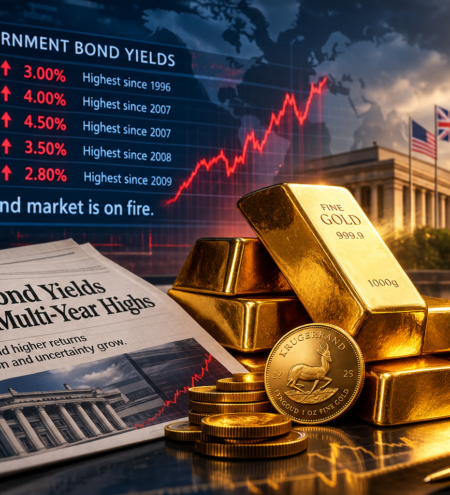
Gold has rebounded as investors seek protection from falling share markets, declining US Treasury yields and renewed uncertainty over inflation and interest rates. The latest price movement highlights the role physical gold can play as a store of wealth when confidence in financial markets begins to weaken.
Gold Rallies as Investors Seek Safety
Gold prices climbed by as much as 1.8% to approach US$4,180 an ounce, recovering some of the previous session’s losses as a technology driven share market sell off encouraged investors to seek safer assets.
Silver also advanced, gaining as investors reassessed the risks facing global financial markets.
The decline in technology stocks triggered renewed demand for US government bonds, pushing Treasury yields to their lowest levels in several weeks. Because gold does not pay interest, lower bond yields can make the precious metal more attractive relative to interest bearing assets.
The US dollar also weakened, providing additional support for gold prices.
However, the latest rally comes against a complicated economic backdrop. Inflation remains a concern, interest rate expectations continue to change and geopolitical tensions have contributed to volatility across energy, equity and commodity markets.
For gold holders, these developments reinforce an important point: gold prices do not move in response to a single factor. Interest rates, currencies, inflation, investor confidence and geopolitical risks can all influence demand.
Inflation Remains a Major Concern
Despite the rebound in gold, the latest US economic figures continue to create uncertainty.
Producer prices and retail sales came in stronger than expected, while consumer price inflation was pushed higher by rising fuel costs. The combination suggests that inflationary pressures may prove more persistent than financial markets had anticipated.
Higher inflation can support demand for gold as investors look for ways to preserve purchasing power. However, if inflation encourages central banks to raise interest rates or keep them elevated for longer, gold can face competing pressures.
This creates a difficult environment for investors who focus exclusively on short term price movements.
Gold may benefit from concerns about inflation and financial instability, yet experience temporary declines when markets anticipate higher interest rates or a stronger US dollar.
The Federal Reserve’s next policy decision will therefore remain an important influence on market sentiment.
Technology Stocks and the Search for a Safe Haven
The latest sell off in technology shares demonstrates how quickly investor sentiment can change.
Companies associated with artificial intelligence have attracted substantial investment, but elevated expectations and concerns about valuations can leave markets vulnerable to sharp corrections.
When investors begin reducing exposure to riskier assets, some seek alternatives such as government bonds, gold and other defensive holdings.
Gold’s appeal is different from that of a technology stock. It does not depend on corporate earnings, future revenue forecasts or the success of a particular business model. Physical gold is a tangible asset whose supply cannot be increased simply because demand rises.
That does not make gold immune to volatility or guarantee that its price will rise during every market correction. Nevertheless, its independence from the earnings and liabilities of individual companies is one reason investors continue to consider it when uncertainty increases.
Geopolitical Tensions and Rising Energy Costs
Gold has also been navigating the consequences of the US-Iran conflict, which has disrupted energy markets and contributed to concerns about global inflation.
Higher fuel costs can flow through the wider economy, increasing transportation, manufacturing and household expenses. If these pressures persist, central banks may face a difficult choice between supporting economic activity and controlling inflation.
For households, the concern extends beyond the immediate price of gold. Persistent inflation can gradually reduce the purchasing power of cash savings, particularly when returns fail to keep pace with rising living costs.
This is one reason gold has maintained a place in the portfolios of individuals, families and institutions for generations. Its role is not necessarily to outperform every other asset in every market cycle, but to provide exposure to a tangible asset outside the conventional financial system.
The Difference Between Owning Gold and Trading Its Price
For Australians considering gold, it is important to distinguish between exposure to the gold price and ownership of physical bullion.
Exchange traded funds and other financial products can provide price exposure without requiring the holder to possess the underlying metal directly. Physical bullion, by contrast, represents ownership of an actual quantity of gold, subject to the particular purchase, storage and ownership arrangements.
These are different propositions, with different costs, risks and considerations.
At FirstGold, the focus is on 100% physical bullion, allowing customers to accumulate gold and silver in dollars or grams rather than needing to purchase a full ounce at a time.
This approach allows customers to build their physical metal holdings gradually, without having to make a single large purchase. Customers can monitor their holdings and manage transactions through the FirstGold app or website.
Learn more at FirstGold.
Why Long Term Ownership Matters
Short term rallies can attract attention, but the more important question for physical gold owners is often whether they hold enough metal to meet their long term objectives.
Trying to predict every market movement is difficult. Even professional analysts can disagree about whether a rally marks the beginning of a sustained advance or simply a temporary recovery within a broader correction.
For those accumulating physical bullion, regular purchases can spread buying across different price levels. This approach, commonly known as cost averaging, reduces the need to commit all available funds at a single price, although it does not eliminate the risk of losses or guarantee a profit.
The objective is not necessarily to buy at the lowest possible price. It is to build ownership over time according to an individual’s circumstances and financial goals.
Gold and silver prices will continue to fluctuate. Neither metal guarantees protection against every economic outcome, and physical bullion should be considered in the context of personal financial needs, liquidity requirements and risk tolerance.
Physical Gold in an Uncertain World
The latest gold rally reflects several forces coming together: falling Treasury yields, a weaker US dollar, concerns about technology stock valuations and continuing uncertainty over inflation and interest rates.
Whether the recovery develops into a sustained advance remains uncertain. Further changes in monetary policy, currency movements and geopolitical conditions could produce additional volatility.
For those who already own physical gold, however, the significance of bullion extends beyond the daily price quotation. Physical metal provides direct ownership of a tangible asset that does not depend on the performance of a company or the promise of a financial intermediary.
At FirstGold, the philosophy is straightforward: build physical gold and silver holdings gradually, understand what you own, and look beyond the daily market noise.
Gold is not simply about trying to get rich from the next price rally. For many holders, it is about preserving purchasing power, diversifying assets and maintaining ownership of something tangible through changing economic conditions.
FirstGold — Build wealth one gram at a time.
Disclaimer: This article is provided by FirstGold for general information and educational purposes only. It does not constitute financial, investment, taxation or legal advice, or a recommendation to buy, sell or hold gold, silver or any other asset.