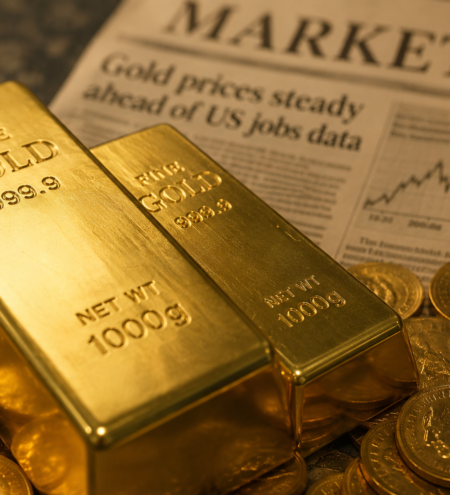
Gold is closing out 2025 much where it spent most of the year—near record highs—leaving investors to debate whether the next move is a decisive breakout or a period of consolidation. As of Sunday, 21 December 2025, spot gold was trading around $4,350 per ounce, keeping prices within striking distance of the 2025 peak near $4,381.
The price action reinforces a key theme of this year’s rally: gold has evolved from a short-term “rate-cut trade” into a structural portfolio asset, supported by central banks, long-term investors and diversification flows.
A rare convergence of drivers
The current setup is shaped by three powerful forces colliding at year-end:
-
Signals from the Federal Reserve suggesting interest rates may remain on hold for months
-
Thin holiday liquidity, which can exaggerate price swings
-
A growing consensus among major banks that gold could still push toward $4,800–$5,000 in 2026, even if gains slow after 2025’s historic surge
Where XAU/USD stands
Live spot pricing on Sunday showed gold around $4,352/oz, modestly higher on the day. Composite XAU/USD pricing feeds placed the metal closer to $4,338, with an indicative daily range between $4,309 and $4,356—a reminder that pricing can vary across feeds, particularly over weekends and during thin trading conditions.
For perspective, 2025 has been exceptional. Gold recorded more than 50 all-time highs during the year and delivered returns of over 60%, driven by geopolitical risk, US dollar weakness and sustained momentum.
Fed ‘hold’ message adds nuance
A key macro headline came from Cleveland Fed President Beth Hammack, who said there is no urgency to change interest rates, signalling policy could remain steady for several months as officials assess inflation and the lagged impact of tariffs on supply chains.
Traditionally, “higher-for-longer” rate expectations weigh on gold by supporting real yields and the dollar. Yet 2025 has defied that textbook relationship. Persistent central-bank buying and diversification-driven investment demand have repeatedly absorbed pullbacks, even when rate cuts were delayed.
2026 forecasts: $5,000 no longer fringe
One of the most striking features of late-December outlooks is how mainstream high-end gold forecasts have become:
-
Goldman Sachs: $4,900/oz by December 2026, citing structurally strong central-bank demand
-
Morgan Stanley: Slower gains, but still targeting around $4,800 by Q4 2026
-
J.P. Morgan: Above $4,600 in Q2 2026 and above $5,000 by Q4 2026, driven by heavy official and investment demand
-
Metals Focus: $5,000 by end-2026
-
Deutsche Bank: $4,450 base case for 2026, with a $3,950–$4,950 range and a $5,150 target for 2027
-
Macquarie: More cautious, forecasting an average of around $4,225 in 2026
-
State Street Global Advisors: Bull case of $4,500–$5,000, assigning a 30% probability to gold reaching $5,000
The ‘underowned gold’ thesis
Despite the rally, strategists argue gold may still be under-allocated. Analysis cited late in December showed gold ETFs make up only a tiny fraction of private US financial portfolios. Even modest increases in allocation, analysts warn, could have an outsized impact in a relatively small market.
Why the gold cycle may not be over
Gold’s surge in 2025 marked its largest annual jump since the 1979 oil crisis, with prices doubling over the past two years. Strategists point to several forces that could extend the cycle into 2026:
-
Central banks as a price anchor, stepping in on dips as part of reserve diversification
-
Broader investor participation, beyond traditional macro and recession trades
-
Record demand, with quarterly global consumption hitting all-time highs
-
An expanding uncertainty premium, tied to geopolitics, fiscal risks and policy credibility
As 2025 draws to a close, gold remains firmly bid near record levels. Whether prices pause or push higher in early 2026, the message from markets is clear: bullion has reasserted itself as a core strategic asset—and $5,000 gold is no longer a fringe forecast.