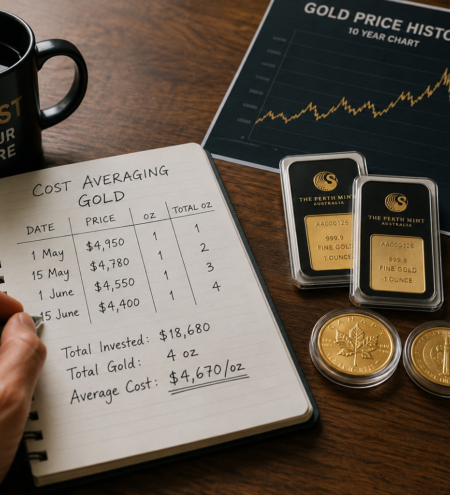
Gold continues to consolidate at historically elevated levels, holding firm near the psychological $5,000 per ounce mark as investors navigate a divided Federal Reserve and escalating geopolitical risks in the Middle East.
After an 18-month stretch of record volatility and breakout rallies, this week — despite a $150 trading range — has felt comparatively calm. Yet beneath the surface, powerful macro forces continue to underpin the precious metals bull market.
Thin Holiday Trade Pushes Gold to Weekly Low — Before Sharp Rebound
Trading began quietly due to the U.S. President’s Day holiday, leaving liquidity thin and volatility amplified. Sellers dominated early in the week, extending last week’s liquidation trend and pushing spot gold down toward $4,860 per ounce, the weekly low.
However, the dip proved short-lived.
With U.S. desks returning on Tuesday, buyers stepped back in aggressively. Whether anticipating softer macro data or positioning for renewed rate-cut expectations, investors drove gold back above $5,000, where it stabilised into midweek.
Federal Reserve Minutes Reveal a Divided FOMC
Midweek focus shifted to the latest meeting minutes from the Federal Reserve, which revealed a committee split into two distinct camps:
-
One faction signalling willingness to resume rate cuts earlier if inflation continues cooling.
-
Another preferring to wait for more consistent evidence before easing policy later in the year.
Markets interpreted the division as a sign that monetary easing may arrive sooner than expected. While gold did not spike aggressively on the news, it remained well-supported just under $5,000 — reinforcing the metal’s resilience amid policy uncertainty.
Lower real interest rates remain structurally supportive for bullion.
Middle East Escalation Sparks “Risk-Off” Surge
On Thursday, reports of increased U.S. military deployments in the Middle East heightened concerns about potential strikes on Iranian targets.
The result: a swift shift into “risk-off” mode.
Oil prices surged, equities wavered, and gold broke decisively back above $5,000 in overnight trade. By Friday, spot prices were pushing toward $5,100 per ounce, positioning the metal for another strong weekly close.
Geopolitical instability continues to inject a risk premium into commodities — particularly traditional safe havens like gold.
Gold to $6,000? Silver to $133? AuAg Funds Sees Major Upside
Swedish asset manager AuAg Funds released its 2026 outlook last week, projecting:
-
Gold rising decisively above $6,000 per ounce this year
-
Silver reaching $133 per ounce
-
Gold potentially moving toward $10,000 in coming years
-
Silver targeting $300 longer term
However, the firm warns investors to expect 20%–30% price swings along the way.
Gold recently hit a high near $5,600 before dropping 20% to test support near $4,400. The subsequent recovery toward $5,000 demonstrates the market’s ability to absorb volatility within a broader bullish structure.
According to AuAg, sharp pullbacks are often engineered shakeouts in strong bull markets:
Large short positions force prices lower, weak hands exit, and strong hands accumulate before the next upward leg.
Structural Forces Driving the Bull Market
AuAg Funds highlights several powerful long-term catalysts:
1. Exploding Global Debt
Global debt is approaching $350 trillion, increasing the likelihood of future monetisation through rate cuts and quantitative easing.
2. Currency Debasement
As fiat currency supply expands faster than real economic output, gold increasingly acts as an alternative monetary asset.
3. Fiscal and Monetary Stimulus
Simultaneous fiscal expansion and monetary easing weaken long-term currency stability — historically bullish for gold.
“Gold responds to fiat currency creation beyond real economic growth.”
Why Silver May Have Even Greater Upside
While gold dominates headlines, AuAg argues silver may offer even stronger percentage potential.
Silver benefits from dual demand:
-
Monetary hedge characteristics
-
Industrial demand, particularly in electronics, solar, and green technologies
After several consecutive years of supply deficits, the silver market may face tightening physical availability.
Importantly, silver demand is relatively inelastic — price increases rarely reduce usage significantly because silver represents a small fraction of finished product costs.
A genuine physical shortage could produce rapid upside repricing.
Mining Equities: The Leverage Play
AuAg also sees strong upside in mining stocks, noting that despite strong performance in 2025, valuations remain below pre-rally levels.
If gold remains above $5,000 or pushes toward $6,000:
-
Mining margins expand significantly
-
Cash flow improves
-
Share prices could outperform bullion
Silver miners, in particular, remain undervalued relative to gold producers.
The Bottom Line
Gold’s consolidation near $5,000 signals strength, not weakness.
A divided Federal Reserve, rising Middle East tensions, and mounting global debt concerns are reinforcing safe-haven demand. While volatility is likely — and sharp pullbacks should be expected — the broader structural bull market thesis remains intact.
Investors should prepare for large swings, but the macro backdrop continues to favour hard assets over fiat currencies.
Disclaimer: This article is for informational purposes only and does not constitute financial advice. Precious metals markets are volatile and involve significant risk. Investors should conduct independent research and consult a licensed financial professional before making investment decisions.