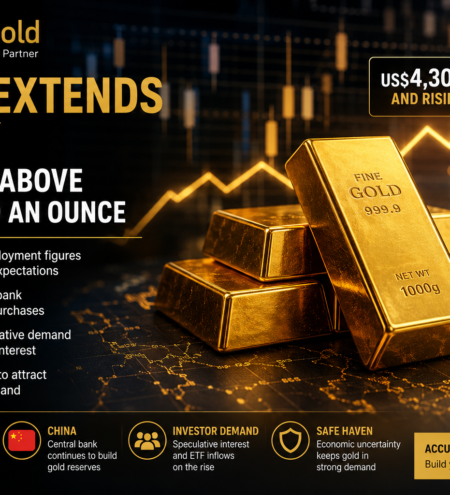
The escalating conflict involving Iran has injected significant volatility into global financial markets, and gold has been no exception. Since the conflict intensified last weekend, the gold price has traded within a wide range between approximately US$5,000 and US$5,400 per ounce, reflecting rapidly shifting investor sentiment and geopolitical uncertainty.
For investors, this environment highlights one key strategy: cost averaging into physical bullion rather than attempting to time short-term market swings.
War Drives Safe-Haven Demand
Gold has already been in a strong structural bull market over the past two years. A major driver has been central banks diversifying reserves away from the US dollar, steadily increasing their gold holdings as part of a broader shift in global reserve management.
At the same time, geopolitical tensions, global trade disruptions linked to tariffs, and persistent economic uncertainty have reinforced gold’s traditional role as a safe-haven asset.
With a new war emerging in the Middle East, that safe-haven demand has intensified. However, the conflict is also creating economic ripple effects that complicate the gold outlook in the short term.
Energy Shock Raises Inflation Risks
One of the immediate consequences of the conflict has been a sharp surge in energy prices.
-
Oil prices have risen approximately 17%
-
Natural gas prices across the UK, Europe and Germany have surged between 35% and 60%
Because every modern economy depends heavily on energy, these price increases ripple through supply chains. Manufacturers, transport companies, and logistics networks all face higher operating costs, which inevitably feed through into consumer prices.
This creates a renewed inflation threat.
Higher inflation pressures central banks to keep interest rates elevated, delaying expected rate cuts. In Australia, that could mean rates staying higher for longer, while in the United States expectations for Federal Reserve rate cuts are now being pushed back.
Higher interest rates can temporarily weigh on gold because gold does not generate yield, unlike savings accounts or government bonds.
Volatility Dominates the Market
Market analysts say the gold market is currently reacting to competing forces.
Peter A. Grant, Vice President and Senior Metals Strategist at Zaner Precious Metals, noted that gold has experienced sharp price swings throughout the week.
Gold briefly surged to five-week highs above US$5,400 before retreating as rising oil prices triggered concerns about inflation and delayed Federal Reserve easing.
The stronger US dollar and rising bond yields then pressured gold lower.
Recent closing prices illustrate the volatility:
-
Monday: US$5,390.45
-
Tuesday: US$5,267.60
-
Wednesday: US$5,131.09
At present, gold is trading around US$5,182 per ounce, slightly higher on the day, marginally lower for the week, but still up around 20% year-to-date.
Despite the pullbacks, the US$5,000 level continues to act as a key support zone for the market.
Why Cost Averaging Into Physical Bullion Makes Sense
In volatile environments like this, attempting to perfectly time the gold market is extremely difficult—even for experienced investors.
That is why many seasoned bullion buyers adopt a cost-averaging strategy.
Cost averaging means buying physical gold regularly over time, regardless of short-term price movements. Instead of trying to pick the exact bottom or top of the market, investors steadily build their holdings while smoothing out price volatility.
This approach offers several advantages:
-
Reduces timing risk during volatile markets
-
Builds long-term bullion holdings gradually
-
Removes emotional decision-making during price swings
-
Captures both dips and rallies over time
In a market that can swing hundreds of dollars in a single week—as gold has recently—cost averaging provides a disciplined and strategic approach to accumulating wealth in physical bullion.
Physical Bullion Remains the Core Strategy
While paper gold instruments and derivatives may fluctuate rapidly during geopolitical crises, physical bullion remains the foundation of long-term precious metal ownership.
Gold’s fundamentals remain strong:
-
Ongoing central bank buying
-
Persistent geopolitical risk
-
Currency instability
-
Rising global debt levels
Even though volatility may continue while the Iran conflict unfolds, these structural drivers continue to support gold’s long-term trajectory.
For investors focused on wealth preservation rather than speculation, accumulating physical gold through disciplined cost averaging remains one of the most effective strategies in uncertain times.
At FirstGold, investors can build their bullion holdings securely and efficiently, using cost-averaging strategies to navigate market volatility while steadily accumulating real, physical gold and silver.