The global financial landscape is shifting rapidly as traditional monetary policies collide with persistent inflation pressures and rising geopolitical tensions. These forces are reshaping investor behaviour and reinforcing the strategic role of gold as a store of value.
Understanding the current gold price outlook requires examining several interconnected drivers, including central bank policy, currency movements, geopolitical risk, and institutional demand. In this evolving environment, disciplined strategies such as FirstGold’s cost averaging purchasing approach are becoming increasingly important for investors seeking long-term exposure to precious metals.
Rather than attempting to time volatile markets, FirstGold enables investors to accumulate gold gradually, strengthening purchasing power while reducing the risk associated with short-term price swings.
Economic Forces Reshaping the Gold Market
Federal Reserve Policy and Interest Rates
The relationship between monetary policy and gold prices extends far beyond simple interest rate movements. When central banks adjust policy settings, the effects ripple across financial markets through several transmission channels.
Recent developments illustrate this clearly. Following weaker-than-expected employment data in February 2026 — with job losses rising and unemployment climbing — markets began pricing in earlier Federal Reserve rate cuts. The shift in expectations triggered an immediate rally in gold, which surged intraday to $5,174.59 per ounce.
Gold responds strongly to these policy shifts because of opportunity cost dynamics. When interest rates decline, yield-bearing assets such as bonds become less attractive compared with non-yielding assets like gold.
Key factors influencing this relationship include:
• Real interest rates after adjusting for inflation
• The Federal funds rate outlook and timing of policy shifts
• Treasury yield curve movements across maturities
• Market expectations embedded in rate futures
For investors using FirstGold’s cost averaging strategy, these fluctuations become opportunities rather than risks. Buying regularly through market cycles allows investors to accumulate bullion regardless of short-term volatility.
The Dollar–Gold Relationship
One of the most consistent patterns in global markets is the inverse relationship between the US dollar and gold prices.
Because gold is priced globally in US dollars, a stronger dollar typically creates pressure on bullion prices. This pattern was visible in early March 2026, when a rising dollar contributed to a 2.3% weekly pullback in gold before employment data triggered a rebound.
Beyond short-term currency moves, structural changes in the global monetary system are also supporting gold demand. Central banks are increasingly diversifying reserves away from the US dollar, creating long-term structural demand for precious metals.
This shift reinforces the value of building a gold position gradually. FirstGold’s cost averaging purchasing model allows investors to accumulate metal consistently while currency and policy cycles evolve.
Central Banks Are Accumulating Gold
Central banks have become one of the most powerful long-term drivers of gold demand.
Unlike speculative traders, these institutions operate on multi-decade time horizons. Their buying decisions are typically based on financial stability, reserve diversification, and geopolitical risk management.
In the current environment of global trade friction and geopolitical uncertainty, central banks are steadily increasing gold allocations because of its unique characteristics:
• No counterparty risk
• High liquidity in crisis periods
• Long-term stability
• Protection against monetary expansion
This institutional demand creates a structural support level for gold prices, strengthening the long-term outlook for the metal.
De-Dollarisation and the Changing Monetary System
A gradual shift away from a dollar-centric financial system is also influencing global gold demand.
As geopolitical tensions rise and international alliances evolve, more countries are diversifying their reserves and trade settlement mechanisms. This trend increases the strategic importance of gold as a neutral reserve asset independent of any single currency.
Recent escalation in Middle East tensions has further intensified this trend, with global markets reacting to uncertainty around energy supply, regional stability, and economic growth.
These long-term monetary changes reinforce the case for building gold exposure steadily rather than attempting to trade short-term price movements.
Geopolitical Risk and Safe-Haven Demand
Periods of global instability consistently drive investors toward safe-haven assets.
Recent market activity demonstrates this dynamic. Energy markets surged as tensions escalated in the Middle East, with Brent crude rising over 9% in a single week and WTI climbing more than 15%.
During such periods, gold serves multiple roles:
• A safe-haven asset during financial market stress
• An inflation hedge when energy prices surge
• A liquidity reserve during market volatility
These factors often drive capital flows into bullion markets during times of uncertainty.
Gold Technical Outlook
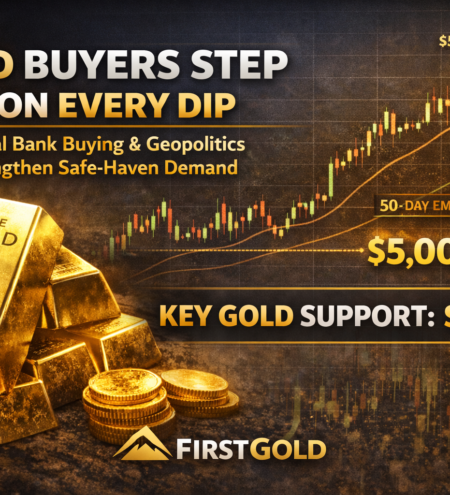
Despite recent volatility, gold remains in a strong upward trend in 2026, having gained nearly 20% year-to-date.
Key technical levels currently guiding the market include:
| Level | Price Range | Significance |
|---|---|---|
| Immediate Support | $5,100 – $5,150 | Recent consolidation zone |
| Strong Support | $4,900 – $5,000 | Major institutional buying level |
| Resistance | $5,200 – $5,300 | Recent highs |
| Major Resistance | $5,500 – $5,600 | Psychological barrier |
Growing trading volumes and wider intraday ranges suggest increasing institutional participation — often a precursor to significant price movements.
Why Cost Averaging Strengthens Buying Power
Attempting to predict exact market highs and lows is extremely difficult, even for professional traders. This is why many experienced investors adopt cost averaging strategies when accumulating precious metals.
FirstGold’s cost averaging model provides several key advantages:
• Reduces exposure to short-term price volatility
• Builds a gold position gradually over time
• Improves purchasing power across market cycles
• Removes emotional decision-making from investing
By purchasing bullion at regular intervals, investors naturally buy more when prices dip and less when prices rise, smoothing their overall acquisition cost.
The Bottom Line
Gold markets are currently being shaped by powerful global forces — including Federal Reserve policy shifts, rising geopolitical risk, central bank reserve diversification, and structural changes in the international monetary system.
These drivers support a strong long-term outlook for precious metals, even as short-term volatility continues.
For investors looking to build wealth protection in uncertain times, FirstGold’s disciplined cost averaging purchasing strategy offers a simple and effective way to accumulate bullion while strengthening long-term purchasing power.
Disclaimer: The information provided in this article is for general information purposes only and does not constitute financial, investment, or trading advice. Market conditions can change rapidly and past performance is not indicative of future results. Readers should conduct their own research or consult a qualified financial adviser before making any investment decisions. FirstGold accepts no liability for any decisions made based on the information contained in this article.