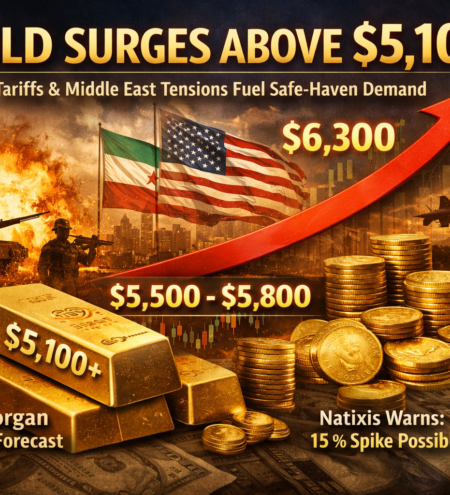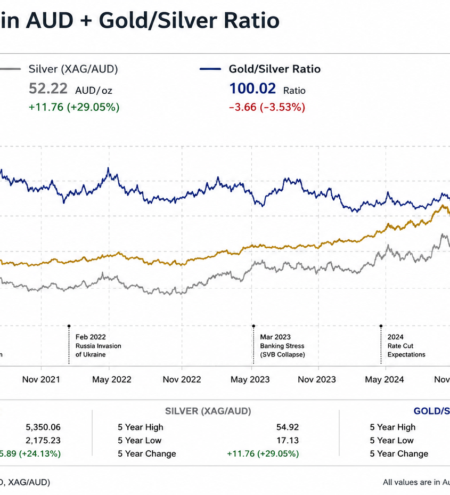
Gold has just recorded its weakest monthly performance since 2013, yet beneath the surface the broader bullish trend remains firmly intact. What we are witnessing is not the failure of gold as a safe haven, but a temporary reset within a powerful long term uptrend.
According to market analysis from Goldman Sachs Group Inc. and other Wall Street strategists, gold could still rally as much as 35 percent in the months ahead, with conditions now aligning for a renewed upward move.
A Market in Transition Not Decline
After reaching record highs near US$5,600 per ounce, gold corrected sharply and is now stabilising in the US$4,500 to US$4,600 range. This pullback reflects a shift in market dynamics rather than a breakdown in fundamentals.
The gold market is no longer reacting in a simple or linear way to global events. Instead, it is navigating a far more complex macro environment where inflation pressures, interest rate expectations, and geopolitical risk are all competing for influence.
From Safe Haven Surge to Inflation Shock
At the start of the Iran conflict, gold responded exactly as expected. Investors rushed into the metal, driving prices sharply higher in a classic flight to safety.
However, as the situation escalated and energy markets tightened, the narrative changed.
Oil prices surged due to supply concerns, particularly around critical shipping routes. This triggered a wave of inflation fears across the global economy. As inflation expectations rose, so too did bond yields and the strength of the United States dollar, creating short term pressure on gold.
The market effectively shifted from a flight to safety into a pricing of sustained inflation, where energy and yield driven assets temporarily outperformed.
Stabilisation Signals a Shift in Market Thinking
Gold’s recent stabilisation suggests that markets are beginning to reassess the balance between inflation and economic growth.
While energy prices continue to point toward persistent inflation, there is growing concern that these conditions will ultimately slow global economic activity. This creates a critical turning point.
Historically, environments where inflation remains elevated but growth begins to weaken have been highly supportive for gold.
The recent price action indicates that forced selling and liquidation have largely subsided. Investors are now moving away from reactive positioning and returning to more strategic allocation into physical assets.
Policy Uncertainty Returns as a Key Driver
Interest rate expectations remain central to gold’s direction.
Rising inflation initially caused markets to question whether central banks would delay rate cuts, placing pressure on gold. However, as volatility continues and growth concerns re emerge, the policy outlook is becoming increasingly uncertain.
This uncertainty is one of the strongest bullish drivers for gold.
Gold performs best when confidence in central bank direction weakens and forward guidance becomes unreliable. In today’s environment, that uncertainty is growing, not shrinking.
A Structural Shift in How Gold Trades
Gold is no longer trading purely as a defensive asset. It is evolving into a broader macro instrument that responds to liquidity, real yields, currency movements, and systemic risk all at once.
The recent correction coincided with rising yields and strong energy markets. The current stabilisation suggests those pressures are beginning to ease, allowing gold to re establish its footing.
This is not a reversal. It is a recalibration.
The FirstGold Perspective
For FirstGold clients, this environment reinforces a principle we have advocated for over a decade.
Short term volatility is part of the journey. Long term accumulation is the strategy.
Periods of correction such as this are not signals to exit the market. They are opportunities to build positions at more favourable levels before the next leg higher.
With central banks continuing to accumulate gold, global debt levels expanding, and geopolitical risk becoming more entrenched, the structural case for gold remains stronger than ever.
Gold’s recent decline may have been its sharpest in years, but it has not altered the underlying trajectory.
What we are seeing is a market adjusting to a new reality where inflation shocks, geopolitical instability, and uncertain monetary policy interact in complex ways.
As these forces continue to unfold, gold is not weakening. It is resetting.
And from that reset, the next major move higher is already beginning to take shape.
Disclaimer: The information contained in this article is provided for general information purposes only and does not constitute financial, investment, or personal advice. While every effort has been made to ensure the accuracy of the content, no representation or warranty, express or implied, is made as to its completeness or reliability.