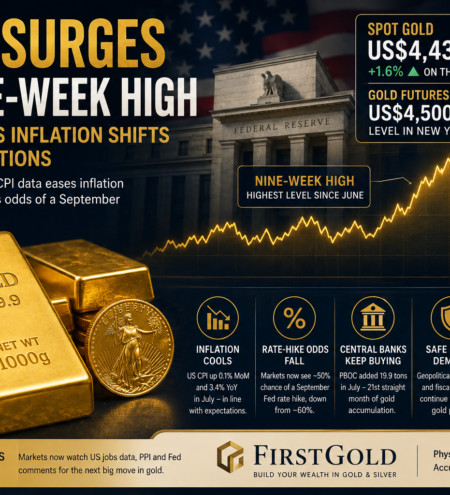
Gold prices slipped early Tuesday, signalling that the precious metal may be entering a period of consolidation after an extraordinary run. The $4,200 per ounce level appears to be emerging as a critical zone of support, as traders assess whether the market can maintain its upward momentum or if a deeper correction is underway.
Initially, gold attempted to rally but soon lost steam, retreating toward the $4,200 support area. The price action suggests that the market may continue to oscillate between $4,200 and $4,400, forming a sideways or “back-and-forth” pattern that often follows strong parabolic gains.
Support and Resistance: The Key Battle Zones
For now, the $4,200 level looks like the line in the sand for gold bulls. Should this level hold, we could see renewed buying momentum that may eventually lift prices back toward $4,400 and beyond.
However, a decisive break below $4,200 could trigger a move lower — potentially toward the $4,000 region, where long-term buyers may look to re-enter the market.
Meanwhile, silver has surged above $50 per ounce in the futures market, a move that could generate spill-over effects into gold trading. While silver tends to experience greater volatility due to its industrial demand, gold continues to act as a safe-haven asset, offering stability amid global uncertainty.
Market Dynamics: A Healthy Breather
After months of relentless gains, the current pullback may actually represent a healthy consolidation phase. Markets rarely move in straight lines, and even in strong uptrends, periods of sideways movement are essential to re-establish value and allow for sustainable future growth.
The gold chart is beginning to show what traders call a “barcode pattern” — a formation of alternating highs and lows over a short period. This pattern often reflects indecision, where buyers and sellers battle for control. While it can be frustrating for short-term traders, this “choppy” price action may help stabilise the market before the next leg higher.
The Bigger Picture: Uptrend Intact
Despite near-term volatility, the long-term uptrend in gold remains intact. Even if prices were to fall by $200–$400, the underlying fundamentals — strong central-bank buying, persistent inflation concerns, and global geopolitical tensions — continue to support elevated gold prices.
In short, while a breather is likely, gold remains a cornerstone asset for investors seeking stability and long-term value preservation. Experienced market participants see dips like this not as threats, but as opportunities to accumulate.
FirstGold Insight
At FirstGold, we view the current environment as one where patience pays. Attempting to short gold during a structural uptrend carries significant risk. Instead, investors may consider gradual accumulation strategies, such as cost-averaging, to take advantage of price fluctuations without the pressure of perfect timing.
Whether the current move evolves into a minor correction or simply a sideways pause, the long-term narrative remains unchanged: gold continues to shine as a hedge against uncertainty and a store of enduring value.
Disclaimer: This article is for informational purposes only and does not constitute financial advice. Precious metals markets are volatile and can result in losses. Readers should conduct their own research and seek professional financial advice before making investment decisions. Past performance is not indicative of future results.