
Gold is one of the world’s most treasured precious metals, but before it reaches refineries, investment vaults, or jewellery workshops, it begins its journey as ore in the earth. Gold ore refers to naturally occurring rock or mineral deposits that contain gold in a concentration high enough to be economically mined and processed.
Not all gold ores are the same. Their characteristics—such as how the gold is formed, where it is found, and how it is distributed within the rock—determine the mining and extraction methods needed. Below is a detailed and educational overview of the main types of gold ores commonly found in mining operations around the world.
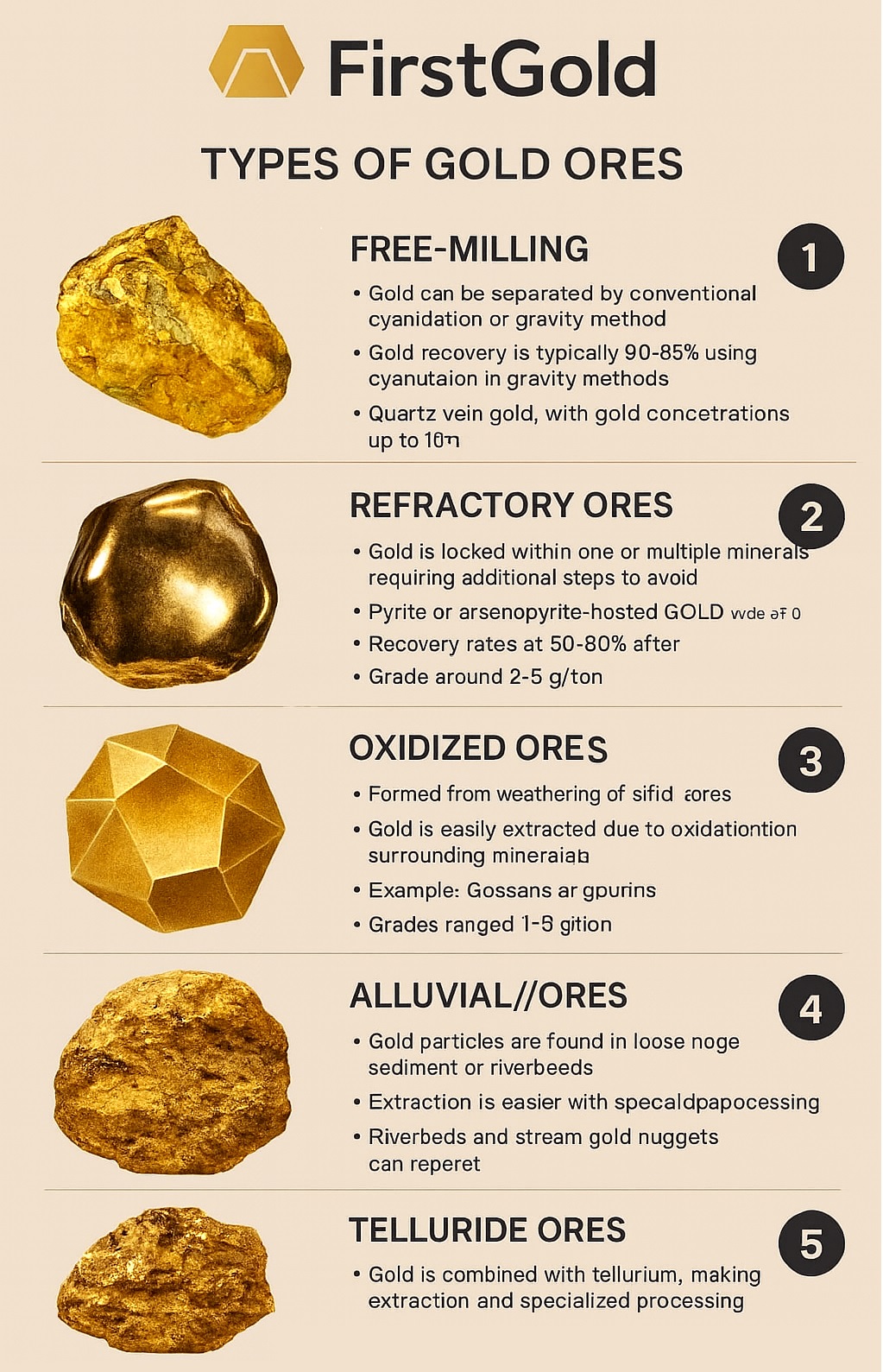
Free-Milling Ores
Free-milling ores are the most straightforward type of gold ore to work with. In these deposits, the gold is liberally distributed and can be easily separated from the rock using standard extraction methods such as:
- Gravity separation
- Cyanidation
These ores require minimal pre-treatment, making them cost-effective and highly desirable for mining companies.
Refractory Ores
Refractory ores present a greater challenge. In these deposits, the gold is locked within other minerals—often sulphides—making standard recovery techniques ineffective. To unlock the gold, miners need additional pre-treatment processes such as:
- Roasting
- Pressure oxidation
- Bio-oxidation
These extra steps increase production complexity and processing cost, but are essential to extract the gold efficiently.
Oxidised Ores
Oxidised ores are formed when sulphide-bearing deposits undergo natural weathering and chemical changes over millions of years. This oxidation breaks down the mineral structure, making the gold easier to extract. Processing oxidised ores is often simpler and less energy-intensive than treating refractory ores, which makes them attractive mining targets.
Alluvial Ores
Alluvial gold deposits are found in:
- Riverbeds
- Flood plains
- Sediments carried downstream over time
These ores usually contain gold in the form of nuggets, coarse grains, or fine particles. Extraction is commonly achieved using gravity-based methods such as:
- Panning
- Sluicing
- Dredging
Alluvial deposits were historically the source of many famous gold rushes, including those in Australia, the United States, and South Africa.
Telluride Ores
In telluride ores, gold is chemically combined with the element tellurium. These deposits require more specialised processing techniques, such as:
- Roasting
- Specialised chemical treatment
Although they are more complex to treat, these ores can be highly profitable, particularly when gold grades are high.
Why Understanding Ore Types Matters
For gold miners, investors, and refiners, knowing the type of ore being processed is crucial. The ore type affects:
- Extraction methods
- Operational costs
- Environmental impact
- Processing efficiency
With global demand for gold continuing to rise, greater innovation in ore processing—especially for refractory and complex ores—remains an essential part of the mining industry’s progress.
At FirstGold, education and transparency are central to understanding the gold ecosystem from mine to market, helping customers and investors make informed decisions about the precious metal they value most.