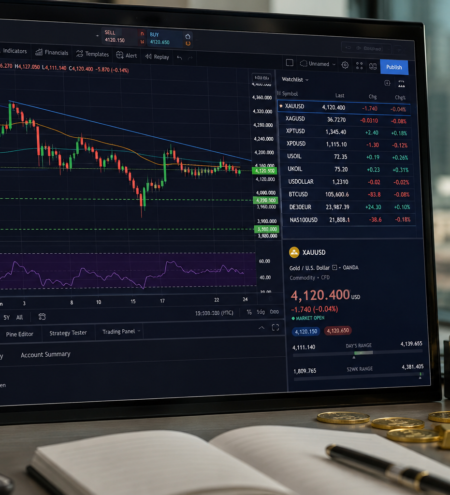
The gold market is attempting to regain stability after recent sharp volatility, with prices rebounding during early Wednesday trade as investors continue to buy the dip. After briefly breaking below key levels, gold is once again eyeing a move back above the crucial $5,000 resistance zone, with technical momentum suggesting a possible retest of $5,150 in the near term.
If bulls reclaim control above that level, the next phase of the structural uptrend could accelerate significantly.
Gold Market Update: Recovery After Heavy Selling
Recent sessions saw intense selling pressure that rattled confidence across the precious metals sector. The scale of the one-day decline created what many traders described as “market trauma,” forcing leveraged positions to unwind rapidly.
However, the latest bounce signals that longer-term buyers remain active.
Importantly, volatility has begun normalising. After several weeks of extreme price swings, daily ranges are gradually returning to more typical levels. This stabilisation phase is often a constructive sign within a broader bull market.
The key question now: Can investors remain patient enough to let the trend rebuild?
Key Gold Support and Resistance Levels to Watch
From a technical perspective, several major support levels are providing a foundation:
-
$4,800 – Strong psychological and structural support
-
50-day EMA – Trend continuation indicator
-
Rising long-term uptrend line
These zones are attracting fresh buyers, particularly as macroeconomic drivers remain firmly supportive of gold.
On the upside:
-
$5,000 – Critical breakout level
-
$5,150 – Momentum trigger zone
-
Above $5,150 – Potential for accelerated upside
A sustained break higher would reinforce the broader bullish structure that has defined the market throughout 2025 and into 2026.
Why Gold Remains Structurally Supported
Despite recent volatility, the fundamental drivers behind gold’s rally have not disappeared. Investors continue to focus on:
-
Federal Reserve rate cut expectations
-
Persistent sovereign debt concerns
-
Geopolitical uncertainty
-
Currency debasement pressures
-
Institutional diversification away from traditional assets
Gold remains in a well-defined long-term uptrend supported by macroeconomic uncertainty and central bank accumulation.
Could Gold Reach $6,000 in 2026?
Several prominent market professionals believe gold’s rally is far from over.
Thomas Winmill, portfolio manager at Midas Funds, argues that the current uptrend began when the U.S. dollar became increasingly used as a geopolitical tool. In response, foreign central banks have accelerated gold purchases to diversify reserves away from U.S. dollar-denominated assets.
Winmill forecasts gold could finish 2026 above $6,000 per ounce.
Meanwhile, analysts at Global X remain bullish, citing:
-
Continued central bank buying
-
Limited Western investor allocation
-
Worsening global sovereign debt outlook
-
Early stages of a structural bull market
They also highlight significant opportunity in gold mining equities, which have underperformed relative to bullion despite record gold prices.
Why Volatility May Continue
Not all experts expect a smooth climb.
Advisers at Flynn Zito Capital Management caution that gold does not generate earnings or cash flow like equities. Instead, its price is largely driven by:
-
Investor sentiment
-
Inflation expectations
-
Interest rate policy
-
Market uncertainty
As a result, continued two-way volatility is likely.
Similarly, strategists at Concurrent Wealth Management emphasise that gold’s sharp swings reflect broader institutional uncertainty rather than weakness in the metal itself. In periods of policy instability and macro uncertainty, gold historically attracts safe-haven flows.
The consensus view: expect a volatile path, not a straight line higher.
What Investors Should Watch Now
Professional investors are closely monitoring:
-
Commitments of Traders (COT) positioning data
-
Open interest shifts toward stronger capital
-
Whether rallies are driven by fresh demand or short covering
-
U.S. economic slowdown signals
-
Changes in Federal Reserve rate expectations
If economic growth softens and rate cuts materialise, gold could find renewed upside momentum.
However, position sizing is critical. Volatility is likely to remain a defining feature of the 2026 gold market.
Strategic Outlook for FirstGold Investors
At FirstGold, we continue to monitor the structural bull case for precious metals. While short-term corrections are natural after extended rallies, the bigger macro drivers — sovereign debt expansion, central bank reserve diversification, and geopolitical risk — remain intact.
Gold stabilising above $4,800 and reclaiming $5,000 would reinforce the long-term trend.
For investors underweight precious metals, pullbacks may present opportunity. For those already positioned, patience and disciplined risk management remain essential.
Disclaimer: Precious metals investments involve significant price volatility and market risks. Past performance does not guarantee future results. Investors should conduct their own research and consider their financial objectives and risk tolerance before investing.