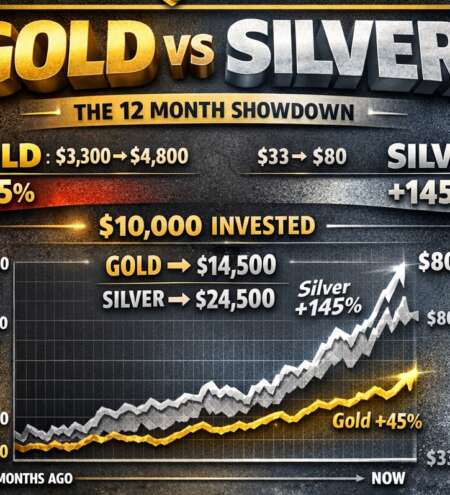
Gold prices have come under renewed pressure, extending recent losses as geopolitical tensions in the Middle East continue to weigh on investor sentiment.
The metal slipped again on Monday, marking its second consecutive weekly decline, as uncertainty surrounding a potential US-Iran deal fuels ongoing inflation concerns. Spot gold dropped as much as 1.8% in early trading before recovering slightly, while US futures also softened, hovering just below recent highs.
Since the outbreak of conflict in the region, gold has retraced around 13%. The reason is not a lack of demand quite the opposite. Elevated energy prices have kept inflation stubbornly high, forcing central banks to maintain a more hawkish stance on interest rates. In the short term, this reduces the appeal of non-yielding assets like gold.
What’s driving markets right now is uncertainty.
Negotiations between the US and Iran appear to have stalled, with Donald Trump reportedly rejecting Iran’s latest proposal. At the same time, tensions around the Strait of Hormuz a critical artery for roughly 20% of global oil supply continue to add another layer of risk to already fragile markets.
This combination of geopolitical instability and inflation pressure is creating volatility across commodities.
Short-term, investors are closely watching upcoming US Treasury borrowing plans, commentary from the Federal Reserve, and key economic data releases. These will provide further clues on the direction of interest rates a major driver for gold.
However, the bigger picture tells a very different story.
Despite recent price weakness, central banks continue to accumulate gold at an aggressive pace. According to the World Gold Council, official sector buying in the first quarter surged to its strongest level in over a year a clear signal of long-term confidence in gold as a reserve asset.
Major financial institutions remain firmly bullish. Deutsche Bank has suggested gold could reach as high as $8,000 per ounce within the next five years, driven by structural demand and a shift away from traditional reserve currencies. Meanwhile, Goldman Sachs and JPMorgan Chase are forecasting prices of $5,400 and $6,300 respectively in the nearer term.
The FirstGold View
Markets rarely move in straight lines. Corrections like this often shake out weak hands but for long-term investors, they present opportunity.
With physical demand strong, central banks buying, and long-term price targets continuing to rise, this pullback should not be seen as a warning sign but as a window.
This is a good time to buy physical bullion.
At FirstGold, we continue to emphasise the importance of owning real, tangible assets. In times of uncertainty, control and security matter more than ever and physical gold remains one of the most reliable stores of wealth available.
Disclaimer: This article is for informational purposes only and reflects general market commentary. It does not constitute financial advice, investment advice, or a recommendation to buy or sell any asset. The views expressed are based on current market conditions, which are subject to change without notice. While every effort has been made to ensure accuracy, no guarantee is given regarding the completeness or reliability of the information provided.