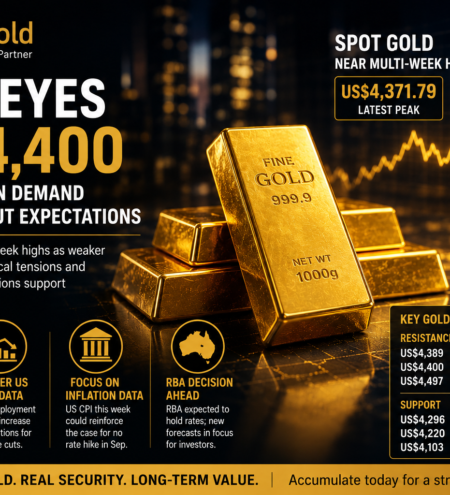
Gold remains closely tied to interest rate expectations in the United States, with recent price action reinforcing the metal’s sensitivity to macroeconomic shifts. During Monday’s session, gold initially sold off before recovering strongly, signalling underlying resilience despite ongoing volatility.
The market is increasingly being driven by expectations around US monetary policy. As interest rates rise, gold—being a non-yielding asset—typically faces downward pressure. However, the ability of bullion to stabilise above the $4,600–$4,700 range suggests that buyers are still active, particularly on dips.
Short-Term Volatility, Long-Term Strength
While the near-term environment remains headline-driven, particularly with developments in the Middle East, the broader outlook continues to favour gold. Traders are approaching the market with caution, recognising that sudden geopolitical shifts can quickly alter sentiment.
The current environment supports a “buy the dip” approach, although positioning remains measured. Volatility is likely to persist, and aggressive exposure carries elevated risk given the sensitivity to both interest rates and geopolitical developments.
Economic Data Fails to Move Gold
Recent US housing data has done little to shift gold’s trajectory. Existing home sales fell 3.6% in March, dropping to an annualised rate of 3.98 million units—below market expectations. Despite the weaker data, gold held steady, last trading near $4,725 per ounce, down marginally on the day.
The muted reaction suggests that the market is currently more focused on interest rates and inflation expectations than on individual economic indicators.
Housing Weakness Could Support Gold
Although the housing data did not immediately lift prices, it may still provide a supportive backdrop. A cooling housing market could weigh on broader US economic activity, potentially prompting the Federal Reserve to consider easing monetary policy.
Lower rates would typically act as a tailwind for gold, reducing the opportunity cost of holding the metal while reinforcing its role as a store of value.
Supply Constraints Keep Housing Prices Elevated
Despite slowing sales, US housing prices continue to rise, driven by limited inventory. The imbalance between supply and demand remains a key structural issue, with economists noting that hundreds of thousands of additional homes are needed to normalise market conditions.
This dynamic has supported household wealth but also highlights underlying economic pressures—factors that continue to underpin long-term demand for gold.
Outlook
Gold appears to be consolidating above $4,700, balancing competing forces of rising interest rates and persistent geopolitical risk. While short-term movements remain uncertain, the broader trend continues to favour higher prices.
For now, the market remains reactive—but with strong underlying support, gold continues to position itself for the next major move.