Something unusual is happening in the precious metals market technical analysts and major global banks are largely pointing in the same direction at the same time.
In most cycles, chart-based forecasting and institutional research rarely align. Traders often disagree on timing, direction, and price targets. But in mid-2025, both sides of the market are increasingly converging on a similar view: significantly higher prices ahead for both gold and silver.
Some analysts are now treating $6,000 gold and $100 silver not as extreme forecasts, but as realistic outcomes within the next cycle.
A market driven by bigger forces
The current strength in precious metals is not being driven by one single factor. Instead, it is the result of several major global shifts happening at once.
A softer US dollar, ongoing fiscal expansion, and persistent geopolitical uncertainty have all contributed to a stronger safe-haven demand for gold and silver. At the same time, central banks have moved from being net sellers of gold in past decades to becoming consistent buyers today.
As noted by the World Gold Council, central banks have recently been accumulating gold at the fastest pace in over a year a clear sign that sovereign institutions are actively diversifying away from fiat currency risk.
Why banks are now lining up on higher price targets
What makes the current environment unusual is the level of agreement emerging among major institutions.
Large investment banks including JPMorgan Chase, UBS, Wells Fargo, Deutsche Bank, and Goldman Sachs are broadly clustering gold forecasts around the $5,400 to $6,300 range for 2026.
Some banks, including Deutsche Bank, have gone further, suggesting that in stronger macro or geopolitical scenarios, gold could extend well beyond that range over the medium term.
While not every institution agrees on timing or magnitude, the direction of travel is becoming harder to ignore.
The technical picture: structure supports the move
From a charting perspective, analysts are also seeing a more defined long-term structure emerge in gold.
After a strong multi-year rally and a recent correction from highs above $5,600, the market now has clearer reference points forming. Support levels in the $4,400–$4,600 range have been repeatedly defended, while resistance above $5,400 remains the key breakout zone for the next leg higher.
This type of structure where both a major high and a major low are established often gives technical analysts more confidence in longer-term projections.
Silver: higher risk, higher upside
Silver has been even more volatile than gold, but also more explosive.
After breaking through long-standing resistance near $50, silver has experienced sharp upside moves that reflect both investment demand and industrial use cases, including solar energy and advanced manufacturing.
Because silver’s market is smaller and more industrially driven, price moves tend to be amplified. That is why forecasts for silver vary widely from conservative estimates around $55–$70, to more aggressive projections near or above $100.
The key debate in the market is not whether silver is moving higher over the long term, but how quickly and how sustainably it can hold those higher levels.
Why this matters for investors
When both technical frameworks and institutional forecasts begin pointing in the same direction, it often signals a shift in broader market psychology.
Gold and silver are increasingly being viewed not just as commodities, but as strategic stores of value in a world of rising debt, currency uncertainty, and geopolitical tension.
This environment has historically favoured physical ownership over paper exposure.
FirstGold perspective
Periods of price consolidation and volatility are not unusual in strong long-term bull markets. In fact, they are often where longer-term positioning opportunities emerge.
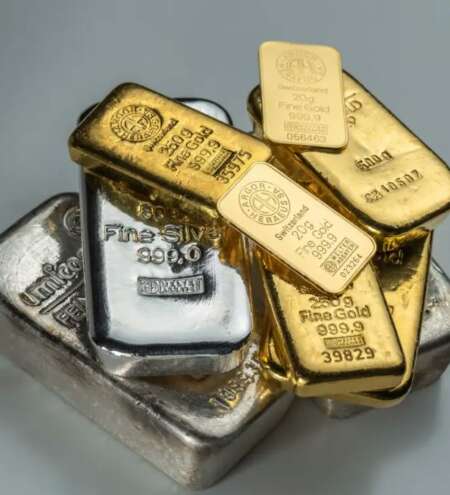
For investors considering exposure to precious metals, the key principle remains simple: owning physical bullion provides direct, tangible exposure to the asset itself, without relying on financial intermediaries or market structures.
Summary
- Major banks are converging on higher gold price forecasts into 2026
- Technical analysis supports a continued long-term uptrend structure
- Central banks are increasing gold purchases at a rapid pace
- Silver remains more volatile, but with significant upside potential
- Market conditions continue to favour long-term physical ownership
In this environment of macro uncertainty and shifting monetary dynamics, the alignment between charts and banks is a signal the market is paying close attention to.
For many investors, this is not just a moment of speculation it is a reminder of the importance of positioning early in long-term cycles.
As always, periods of weakness in price can present opportunities to accumulate physical bullion with a long-term perspective.
Disclaimer: This article is for informational purposes only and reflects general market commentary. It does not constitute financial advice, investment advice, or a recommendation to buy or sell any asset. The views expressed are based on current market conditions, which are subject to change without notice. While every effort has been made to ensure accuracy, no guarantee is given regarding the completeness or reliability of the information provided.