While retail demand has been a significant driver in silver’s parabolic run to record highs above $58, industrial demand has been a critical factor behind the market’s dwindling above-ground stocks and is expected to continue supporting the precious metal’s long-term uptrend.
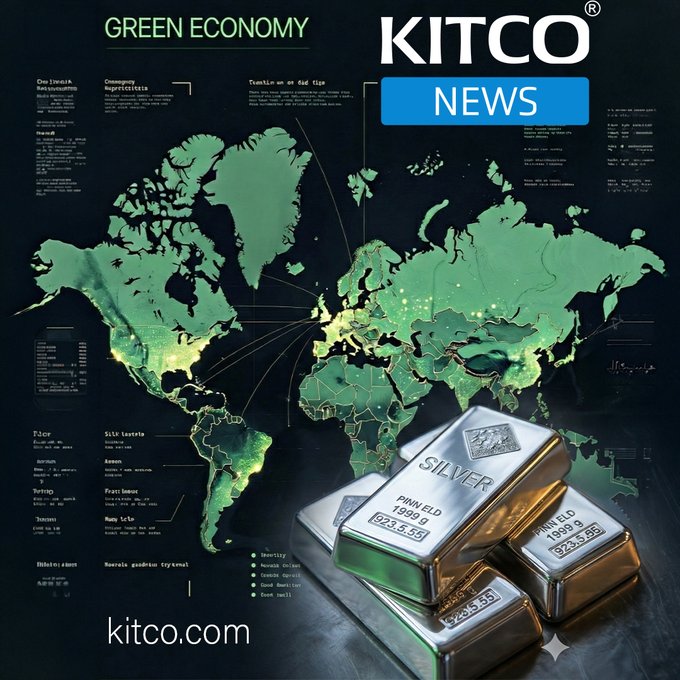
Specifically, the ongoing green energy transition has been a major source of demand for silver. The precious metal is a critical element in photovoltaic solar panels. According to a report from the World Economic Forum, the green energy economy will continue to grow.
In a report published Tuesday, the WEF noted that the green energy economy has been the second-fastest-growing sector over the past decade and is currently valued at more than $5 trillion. Meanwhile, the green energy economy is expected to expand further and exceed $7 trillion annually by 2030, creating abundant growth opportunities for businesses worldwide.
“Despite the current headwinds for global climate action, this report shows that the green economy is not a distant opportunity but already a major growth engine of this decade,” said Pim Valdre, Head of Climate and Nature Economy, World Economic Forum, in the report.
The report noted that growth in the green energy sector has been driven in part by falling infrastructure and technology costs.
“Technological cost declines have accelerated this trend, although solutions are moving at different speeds across markets. Since 2010, the cost of solar photovoltaics and lithium batteries has fallen by around 90% and offshore wind by 50%, making low-carbon solutions increasingly cost competitive. The report estimates that 55% of global emissions reductions needed to decarbonize can now be achieved with solutions that are already cost competitive, with another 20% addressable at minor cost premiums and 5% requiring a behavioural change,” the WEF said.
At the same time, the report noted that China has played a key role in the green energy transition and is expected to continue dominating the sector. China’s influence has grown over the past year as the U.S. has stepped back.
Since the start of its second term, President Donald Trump has cut incentives for renewables under the Joe Biden-era Inflation Reduction Act. In September, the U.S. Department of Energy said it would cancel more than $13 billion in funds that the Biden administration had pledged to subsidize wind, solar, batteries, and electric vehicles.
Although the U.S. will not play a leading role in the green energy transition, commodity analysts have said that the trend is bigger than any single country.
“Three things are striking: the resilience of the green economy, with investments in green technologies jumping from record to record against a change in public headlines and sentiments; China’s leadership in manufacturing, innovation and deployment of green technologies; and the opportunity for companies operating in green markets to outperform and earn a premium in capital markets,” said Patrick Herhold, Managing Director and Senior Partner, Boston Consulting Group.
Looking specifically at silver demand, data from the Silver Institute shows that the solar sector is expected to consume 195.7 tonnes of silver this year. Demand is down slightly from 2024 as silver loading has declined. Although the amount of silver used in individual solar panels could continue to decrease, analysts have said that overall growth in the sector will lead to sustained demand for the precious metal.
“Global installations are set for a new record high. However, due to a sharp drop in the amount of silver used in each module, PV silver demand is forecast to ease by around by 5% y/y,” the Silver Institute said in a report last month.
The bullish outlook for the green energy economy comes as silver prices trade around $58 an ounce, relatively flat on the day but up 100% so far this year.
In an interview with Kitco News last month, Matthew Piggott, Director of Gold and Silver at Metals Focus, said there are expectations for silver to experience annual supply deficits for the foreseeable future.
He added that while higher silver prices will prompt some companies to seek alternatives to silver, such as copper, which is less expensive, the technology is still in its infancy and has not yet been proven commercially viable.
He noted that solar demand for silver could remain robust for the next 12 to 24 months, depending on the evolution of the technology.
Sourc: Neils Christensen Kitco